Yarn
Interlocked fibres used in textiles since the Stone Age.
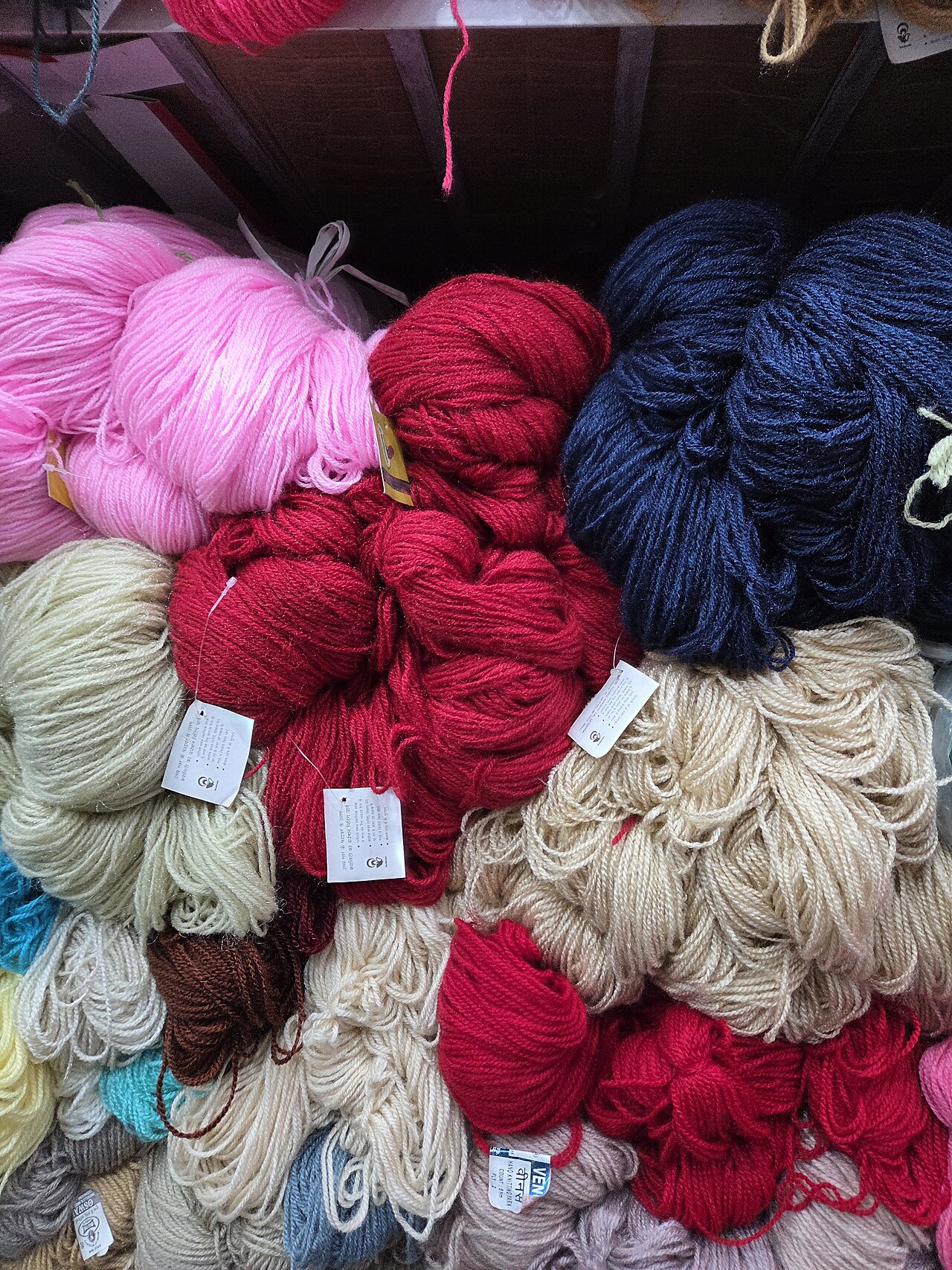
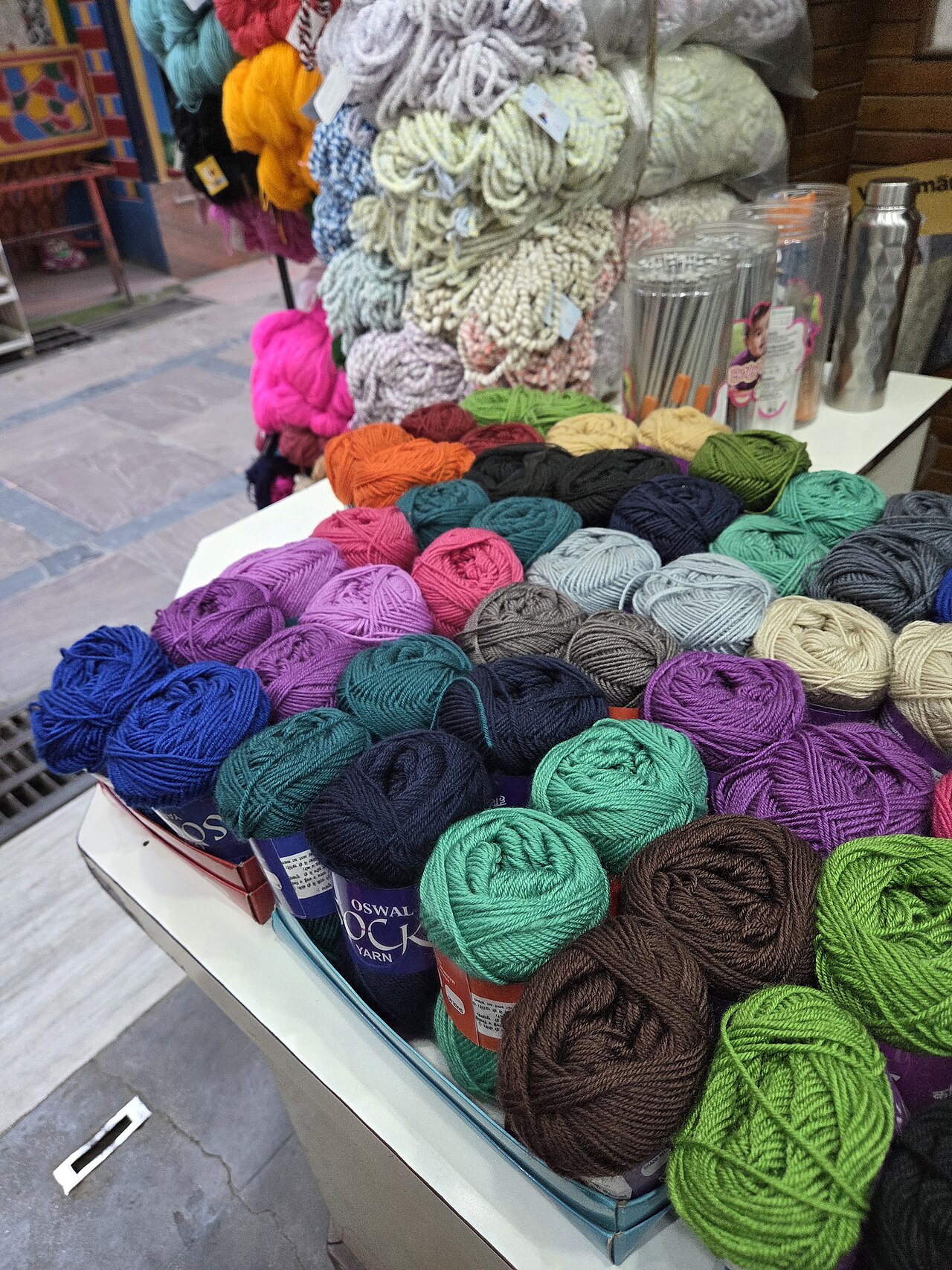
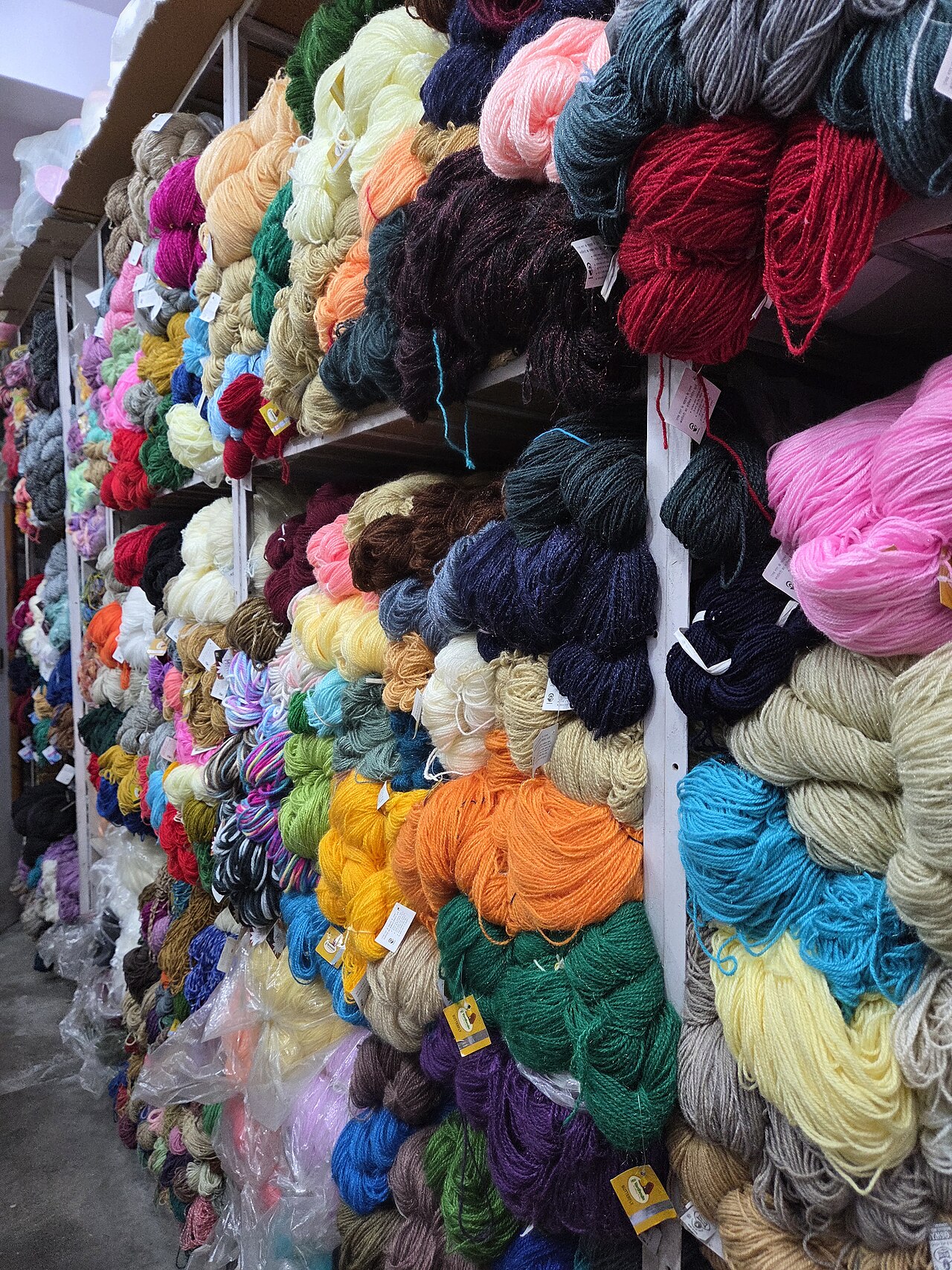
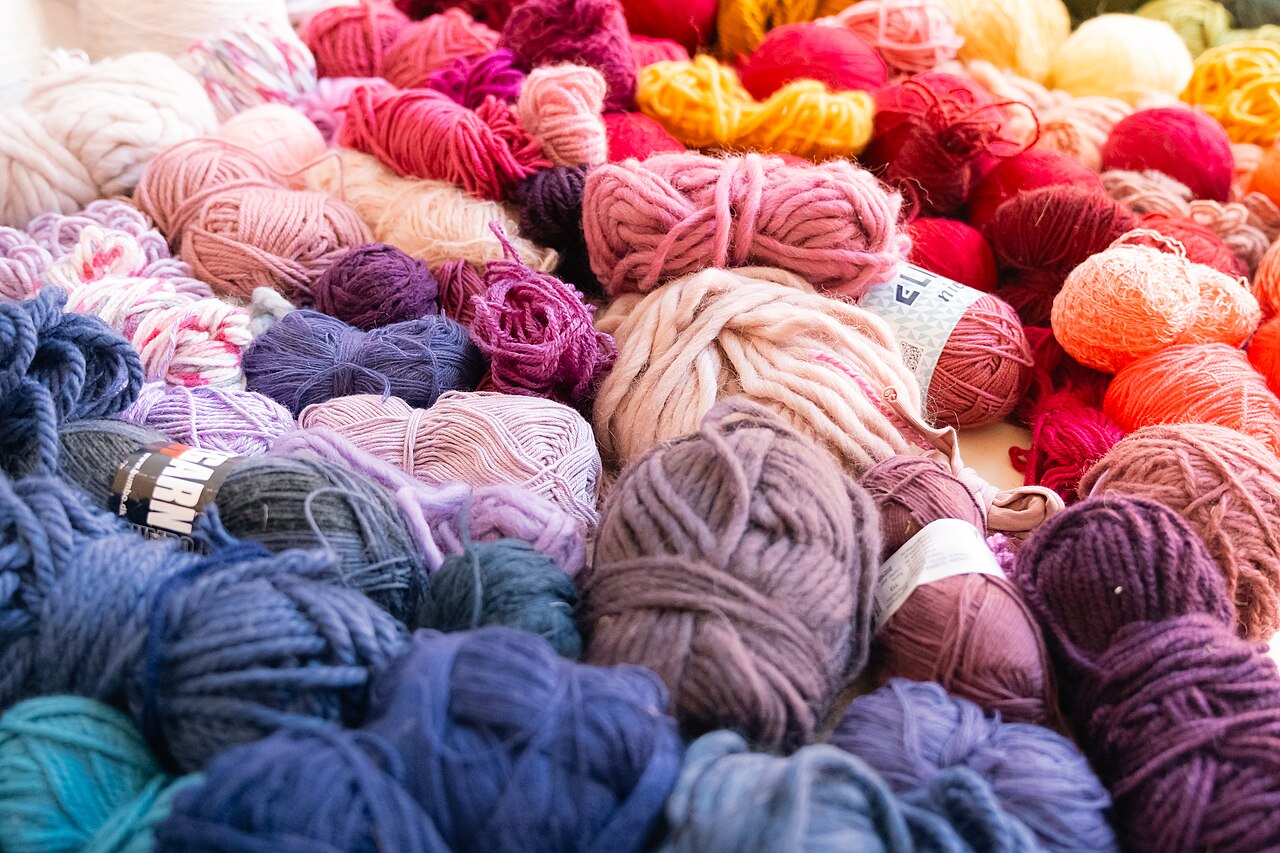
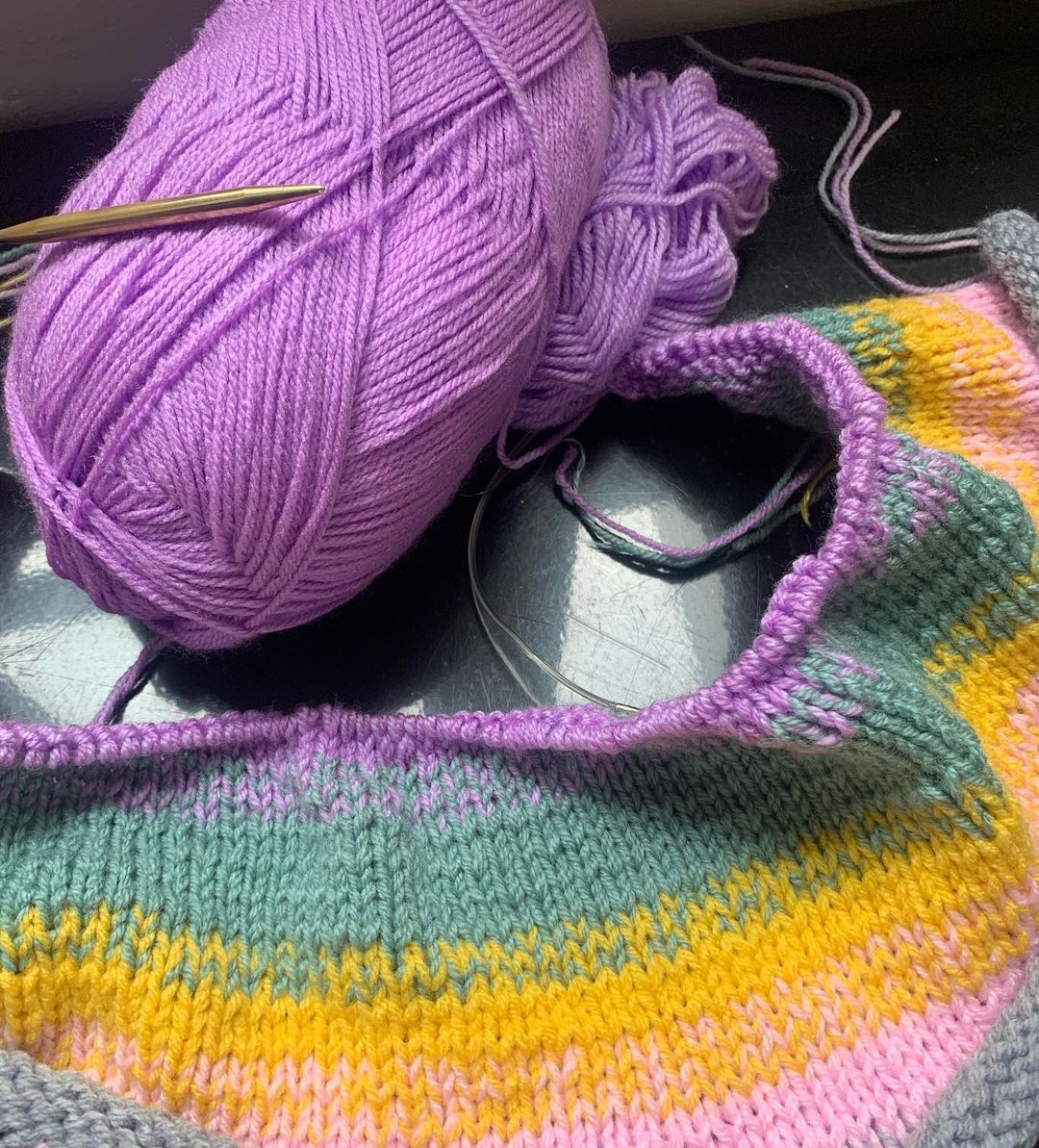
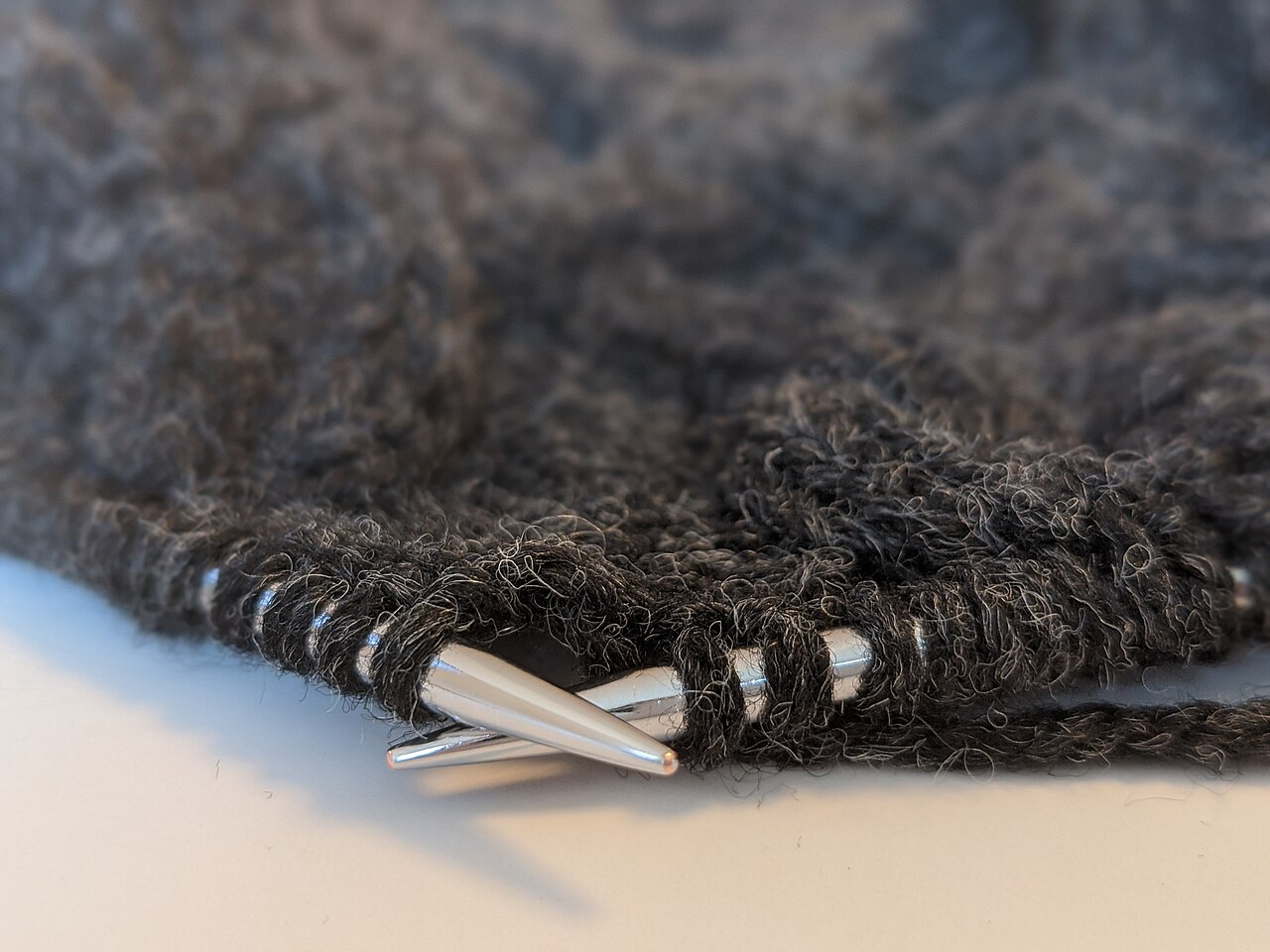
Yarn is a continuous strand of interlocked fibers, used for sewing, crocheting, knitting, weaving, embroidery, rope-making, and textile production. A thread is a specific type of yarn designed for hand or machine sewing. Yarn can be made from natural fibers, synthetic fibers, or a blend of both, and is available in many colors and thicknesses, which are called "weights."
The word "yarn" comes from Middle English, derived from Old English *gearn*, related to Old High German *garn*, Dutch *garen*, Ancient Greek *χορδή* (meaning "string"), and Sanskrit *hira* (meaning "band"). Its original meaning referred to entrails.
Humans have produced yarn since the Stone Age. Early fiber materials included animal hides, reeds, cotton, wool, and silk. The textile trade was a major part of the ancient global economy.
Natural fibers include cotton, the most common plant fiber, typically spun into fine yarn for machine weaving or knitting. Silk is a natural protein fiber composed mainly of fibroin, produced by the larvae of the moth *Bombyx mori*; its production is thought to have started in China, with silk thread and cloth manufacture well-established by the Shang dynasty. Linen fibers come from the flax plant and have a long history in yarn and textiles. Other plant fibers that can be spun include bamboo, hemp, maize, nettle, and soy fiber.
The most common spun animal fiber is wool from sheep. Because longer fibers make better yarn, sheep have been bred over time to produce longer fibers, which increases the need for shearing to prevent pests and overheating. Other animal fibers include alpaca, angora, mohair, llama, cashmere, and silk. More rarely, yarn is spun from camel, yak, possum, musk ox, vicuña, cat, dog, wolf, rabbit, bison, or chinchilla hair, as well as turkey or ostrich feathers.
Synthetic fibers used as yarn include nylon, acrylic, rayon, and polyester. These are generally extruded as continuous strands of gel-state material, then drawn, annealed, and cured to achieve desired properties. Synthetic fibers come in three basic forms: staple (cut fibers, usually up to 120 mm long), tow (a continuous rope of loosely joined filaments), and filament (a continuous strand of one or many filaments). Synthetic fiber is most often measured by weight per linear measurement, with denier and dtex being common units; cut length applies only to staple fiber. Filament extr
- field
- Textile production
- known_for
- Long continuous length of interlocked fibres used in textiles and crafts
- earliest_known_production
- Stone Age
- common_natural_fibers
- Cotton, wool, silk, linen
- common_synthetic_fibers
- Nylon, acrylic, rayon, polyester
Lore & Background
The human production of yarn is known to have existed since the Stone Age, with fiber materials coming from animal hides, reeds, cotton, wool, and silk. Textile trade contributed immensely to the ancient global economy. The word 'yarn' comes from Middle English, from Old English gearn, akin to Old High German garn, Dutch garen, Ancient Greek χορδή (chordē, 'string'), and Sanskrit hira, 'band'; it originally referred to entrails.
Yarn can be made from natural fibers such as cotton, silk, linen, wool, and other animal fibers like alpaca, angora, mohair, llama, cashmere, and even more rarely from camel, yak, possum, musk ox, vicuña, cat, dog, wolf, rabbit, bison, or chinchilla hair, as well as turkey or ostrich feathers. Synthetic fibers include nylon, acrylic fiber, rayon, and polyester, which are generally extruded in continuous strands and then drawn, annealed, and cured. Yarn from recycled materials, such as T-shirt yarn, is considered a recycled and eco-friendly product.
Spun yarn is made by twisting staple fibres together, a process called spinning that dates back to the Upper Paleolithic. Yarn is composed of twisted strands of fiber known as plies, which can be twisted together in opposite directions to create s-twist or z-twist. Combed yarns are produced by an additional combing step that aligns fibres and removes short fibres, resulting in superior-quality fabrics. Hosiery yarns are made softer with fewer twists per inch for knitted fabrics.
Reader's Guide
Yarn is a foundational material in human history, with production dating to the Stone Age and playing a key role in the ancient global economy through textile trade. Its versatility stems from the wide range of natural and synthetic fibers used, each imparting different properties such as warmth, light weight, durability, or softness. The development of spinning, from hand techniques to industrialization, transformed yarn from a handmade necessity into a mass-produced commodity. The choice of fiber, twist direction, and ply structure directly affects the mechanical integrity and final properties of fabrics, as first studied by Galileo. Modern yarns often blend synthetic and natural fibers to combine advantages like strength and comfort. The distinction between carded and combed yarns, as well as hosiery yarns, shows how specialized production methods meet specific textile needs. Yarn remains essential for sewing, knitting, crocheting, weaving, embroidery, and ropemaking, and its production continues to evolve with recycled and eco-friendly options.
Did You Know?
- The word 'yarn' originally referred to entrails.
- Yarn production dates back to the Stone Age.
- Combing yarn removes short fibres, making it softer and smoother.
- T-shirt yarn is considered a recycled and eco-friendly product.
From Fibre to Thread: The Five-Stage Journey
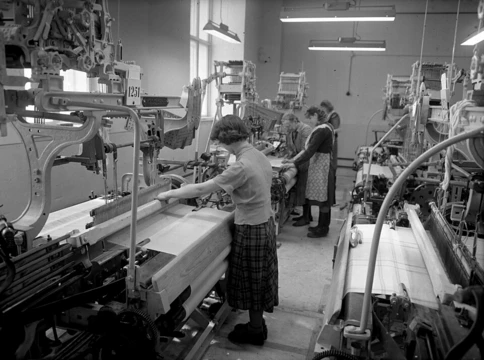
The textile industry's core mission is the design, production, and distribution of yarn, cloth, and clothing, and at the heart of that pipeline sits the transformation of raw material into usable thread. For cotton — the world's most important natural fibre, yielding 25 million tons annually from 35 million hectares across more than 50 countries — the path from field to fabric follows five distinct stages: cultivating and harvesting, preparatory processes, spinning to produce yarn, fabric construction, and finishing to yield the final textile. Each step carries its own technical demands. The preparatory phase varies enormously depending on the source material: flax must undergo retting and dressing, while wool requires carding and washing. Yet once fibres reach the spinning stage, the mechanics of twisting and aligning them into a continuous strand become remarkably similar across fibre types. Textile engineering, the discipline that oversees all of this, spans both natural and synthetic materials, ensuring that what begins as a seed, a plant stem, or a polymer solution ultimately becomes a thread strong enough to be woven into cloth and finished into a garment.
Two Worlds of Fibre: Natural and Synthetic
Yarn can be drawn from two fundamentally different sources, each with its own character and processing demands. Natural fibres come from a remarkable range of organisms and minerals: sheep, goats, rabbits, and silkworms provide animal-based strands, while plants contribute cotton from seeds, bast fibres like flax, hemp, and jute from stems, and sisal from leaves. Even asbestos has been used. With the exception of silk, these natural fibres are short — just a few centimetres long — and possess a rough surface that lets them grip and adhere to neighbouring staples, a quality essential for spinning. Synthetic fibres, by contrast, are born in a factory. A polymer is extruded through a spinneret into a medium where it hardens. The method varies: wet spinning uses a coagulating bath (as with rayon), dry spinning relies on a solvent that evaporates in a heated chamber (acetate, triacetate), and melt spinning cools the extruded strand in gas or air (nylons, polyesters). The resulting threads can stretch for kilometres, are more durable than most natural fibres, and accept dyes readily. They can be processed as long filaments or cut into shorter batches to mimic natural staple behaviour.
Ancient Threads and a Medieval Myth
The story of yarn stretches back further than most people imagine. Faint textile impressions discovered at Pavlov in Moravia hint that weaving knowledge may have existed as early as the Palaeolithic era, while more concrete Neolithic examples — pile-dwelling finds in Switzerland and a site at El Fayum, Egypt dating to roughly 5000 BC — confirm that structured cloth production was well established millennia ago. In Roman Europe, wool, linen, and leather dressed the general population, while silk arriving along the Silk Road from China remained a rare luxury. When cotton began reaching Northern Europe in the late medieval period, its plant origin was a complete mystery to locals. So bewildered were people by the soft, fluffy material that they imagined it must grow on trees like wool from sheep. John Mandeville, writing around 1350, confidently described a wonderful tree in India bearing tiny lambs on its branches. That fanciful image lingered in language: German Baumwolle still translates as tree wool. By the end of the 16th century, cotton cultivation had spread across warmer regions of Asia and the Americas, and spinning technology had evolved from simple hand-twisting to the drop spindle, and eventually to the spinning wheel, likely invented in the Islamic world by the 11th century.
When Machines Took the Spindle
The 18th century shattered the slow, hand-driven rhythm of yarn production. In 1734, John Kay of Bury, Lancashire, introduced the flying shuttle, a device that widened cotton cloth and accelerated a single weaver's output. Workers resisted the technology, fearing job losses, even as the increased cloth demand outstripped the supply of spun cotton. The breakthrough in spinning came in 1764, when James Hargreaves is credited with the spinning jenny, which multiplied a single worker's thread output eightfold and later far beyond. Hargreaves failed to patent the invention until 1770, and industrial unrest forced him out of Blackburn, but the unprotected design spread rapidly — over 20,000 jennies were in use by the time he died. That same year, Thorp Mill at Royton became the world's first water-powered cotton mill, used for carding. The mechanisation of both spinning and weaving triggered a proliferation of cotton mills across England's North West. Meanwhile, the Duke of Bridgewater's 1761 canal linked Manchester to Worsley coal fields, and Boulton and Watt's 1775 steam engine with its separate condenser provided the power that would drive the industry into full industrial scale.
Gallery
More in Textile Production 1-17
Spotted an error? Know more?
This is a living reference — every entry is fact-audited, and reader corrections feed straight into our audit queue. Suggest an edit · See this site's audit record