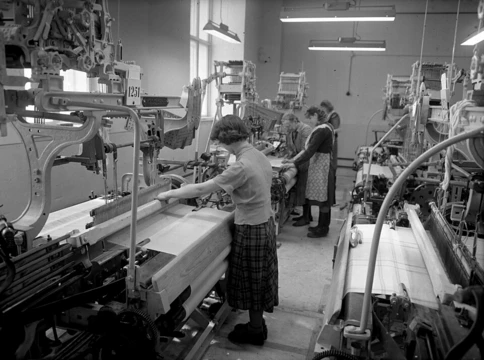
Spinning (polymers)
Polymer fiber formation via spinneret extrusion and solidification.

Wikipedia / Wikimedia Commons
Spinning is a method used to manufacture polymer fibers. It is a specific type of extrusion that relies on a spinneret to produce many continuous filaments at once.
In **melt spinning**, a thermoplastic polymer is heated until it melts. This molten material is pushed through a spinneret, which contains tiny holes called capillaries. The resulting streams of liquid cool and harden into solid filaments. Nylon, olefin, polyester, and saran are all made this way. Polysulfide (Thiokol), however, is typically produced via condensation polymerization and casting or extrusion, not standard melt spinning of thermoplastic filaments.
**Extrusion spinning** starts with solid polymer in the form of pellets or granules. These are fed into an extruder, where a screw compresses, heats, and melts them. The melted polymer then moves to a spinning pump and finally through the spinneret.
**Direct spinning** skips the step of making solid pellets. Instead, the polymer melt comes straight from the raw materials and is pumped directly from the polymer finisher to the spinning mill. This process is mainly used for making polyester fibers and filaments, and it is designed for very high production rates, exceeding 100 tons per day.
If a polymer’s melting point is higher than the temperature at which it starts to degrade, it must be processed using **solution spinning**. The polymer is first dissolved in a solvent to create a spinning solution, sometimes called a "dope." This solution then goes through one of several techniques: dry, wet, dry-jet wet, gel, or electrospinning.
In **dry spinning**, the spinning solution, made of polymer and a volatile solvent, is extruded through a spinneret into an evaporating chamber. A stream of hot air hits the jets of solution, causing the solvent to evaporate and the filaments to solidify. A related method, solution blow spinning, sprays the polymer solution directly onto a target to produce a nonwoven fiber mat.
**Wet spinning** is the oldest of the five processes. The polymer is dissolved in a solvent and then extruded through a spinneret that is submerged in a coagulation bath filled with nonsolvents. The bath causes the polymer to precipitate out as solid fibers. Acrylic, rayon, modacrylic, and some specialty fibers are made this way. Aramid fibers, however, are typically produced via dry-jet wet spinning or dry spinning, not standard we
- materials
- Nylon, olefin, polyester, saran, acrylic, rayon, aramid, modacrylic, spandex, UHMWPE
Lore & Background
Spinning is a specialized extrusion process that creates multiple continuous filaments by forcing polymer through a spinneret. If the polymer is a thermoplastic, melt spinning is used: the molten polymer is extruded through capillaries and solidified by cooling. Nylon, olefin, polyester, and saran are produced this way. Polysulfide (Thiokol), however, is typically produced via condensation polymerization and casting or extrusion, not standard melt spinning. Extrusion spinning feeds solid pellets into an extruder, where they are compressed, heated, and melted before reaching the spinneret. Direct spinning avoids solid pellets entirely, producing polymer melt directly from raw materials and pumping it to the spinning mill; this is mainly applied in high-capacit
Reader's Guide
Spinning (polymers) is a foundational manufacturing process that enables the production of synthetic fibers used in textiles, industrial materials, and medical applications. The variety of techniques—melt, extrusion, direct, solution, and electrospinning—allows adaptation to different polymer chemistries and desired fiber characteristics. Melt spinning is efficient for thermoplastics, while solution spinning handles polymers that degrade before melting. Direct spinning boosts production capacity for polyester. Gel spinning yields ultra-strong fibers like UHMWPE, and electrospinning produces micro- or nanoscale fibers for specialized uses. Post-spin drawing further enhances fiber strength and orientation. The process's versatility and scalability have made it central to the modern synthetic fiber industry, though the article notes no specific dates, persons, or places.
Did You Know?
- Spinning is a specialized form of extrusion that uses a spinneret to form multiple continuous filaments.
- Wet spinning is the oldest of the five spinning processes described.
- Direct spinning is dedicated to high production capacity, exceeding 100 tons per day for polyester.
- Electrospinning does not require coagulation chemistry or high temperatures to produce solid threads from solution.
Melt Spinning – The Thermoplastic Pathway
Melt spinning is the route taken when a polymer is a thermoplastic, meaning it can be melted and reshaped without chemical breakdown. The process begins with solid pellets or granules of polymer being fed into an extruder, where a rotating screw compresses, heats, and melts the material. The resulting molten stream is then pumped through a spinneret—a plate pierced with numerous tiny capillaries—that simultaneously forms multiple continuous filaments. As these filaments emerge, they are cooled and solidified into their final fiber form. This straightforward melt-to-fiber approach is responsible for producing widely used materials including nylon, olefin, polyester, saran, and sulfar. A notable variation called direct spinning skips the pellet-making stage entirely: the polymer melt is generated directly from raw materials in a polymer finisher and pumped straight to the spinning mill. This streamlined workflow is primarily employed in high-volume polyester fiber and filament production, where daily output exceeds one hundred tons.
Solution Spinning – Dry and Wet Routes
When a polymer's melting point sits above its degradation temperature, simply heating it into a liquid is no longer viable. In such cases, solution spinning becomes necessary. The polymer is first dissolved in a suitable solvent to create a spinning solution, often referred to as a dope. From there, two classic routes diverge. In dry spinning, the dope is extruded through a spinneret into a chamber where a stream of hot air blows across the emerging jets, evaporating the volatile solvent and solidifying the filaments. A related technique called solution blow spinning sprays the polymer solution directly onto a target surface to form a nonwoven fiber mat. Wet spinning, the oldest of the five solution-based methods, takes a different approach: the spinneret is submerged in a coagulation bath of nonsolvents, and the polymer precipitates out of solution into fiber form as it passes through. Acrylic, rayon, aramid, modacrylic, and spandex all rely on this wet-spinning chemistry. A hybrid variant, dry-jet wet spinning, introduces a short air gap before the coagulation bath, a step used in Lyocell spinning of dissolved cellulose that can yield greater polymer orientation because the solution is more stretchable than the already-precipitated fiber.
Gel Spinning and Electrospinning – Pushing Fiber Performance
Two less conventional techniques push polymer fibers beyond what standard spinning can achieve. Gel spinning, sometimes called semi-melt spinning, replaces the precipitation mechanism of wet spinning with temperature-induced physical gelation. As the spun jet is cooled—either by air or a liquid bath—the polymer chains lock into a gel structure that retains a high level of solvent, much like a gelatin dessert. This solvent retention keeps the chains bound together and resists the relaxation that typically occurs in wet spinning. The result is the ability to perform ultra-high drawing, a process exploited in ultra high molecular weight polyethylene fibers such as Spectra, where extreme orientation translates into exceptional strength. Some high-strength polyethylene and polyacrylonitrile fibers are also made this way. Electrospinning takes an entirely different route: an electrical charge draws extremely fine fibers, typically at the micro or nano scale, from either a polymer solution or melt. Because it avoids coagulation chemistry and high temperatures, the method is well suited to large, complex molecules that would degrade under conventional conditions. A melt electrospinning variant ensures no solvent residue remains in the final product.
The Spinneret and the Final Draw – Where Filaments Become Fiber
At the heart of every spinning method—whether melt, dry, wet, gel, or electrospinning—lies the spinneret, a component that transforms a continuous stream of polymer into multiple discrete filaments simultaneously. In melt spinning, the spinneret is a plate of capillaries through which the molten polymer is forced; in solution spinning, the dope or gel jet passes through similar openings before encountering hot air, a coagulation bath, or an electrical field. The geometry and number of these capillaries directly determine how many filaments are produced in a single pass. Once the filaments have solidified, a final post-spin step called drawing is applied to increase both strength and molecular orientation. Drawing can be performed while the polymer is still in the process of solidifying or after it has fully cooled, and it stretches the fiber to align the polymer chains more tightly. This alignment is what ultimately gives the finished fiber its mechanical properties. Together, the spinneret and the drawing stage bookend the spinning process, converting a raw polymer stream into a structurally organized, high-performance fiber ready for textile or industrial use.
Gallery
More in Textile Production 1-17
Spotted an error? Know more?
This is a living reference — every entry is fact-audited, and reader corrections feed straight into our audit queue. Suggest an edit · See this site's audit record