Spinning jenny
Multi-spindle spinning frame that boosted textile productivity.

Wikipedia / Wikimedia Commons
The spinning jenny, a multi-spindle frame for spinning, played a major role in the early Industrial Revolution’s textile manufacturing. James Hargreaves created it around 1764–1765 in Stanhill, Lancashire. By allowing a single worker to operate eight or more spools at once, it cut the labor needed to make cloth; later versions handled up to 120 spools. This invention helped launch the factory system for cotton production.
James Hargreaves, born near Blackburn around 1720, came from a town of about 5,000 people known for “Blackburn greys”—cloth with linen warp and cotton weft, a local Lancashire fustian product, often sent to London for printing. At the time, cotton yarn output couldn’t meet textile demand. John Kay’s flying shuttle (1733) had doubled weavers’ productivity, creating a greater need for yarn. Hargreaves’s jenny met that need by boosting spinners’ output even more, and it could produce a range of thread qualities, including finer counts.
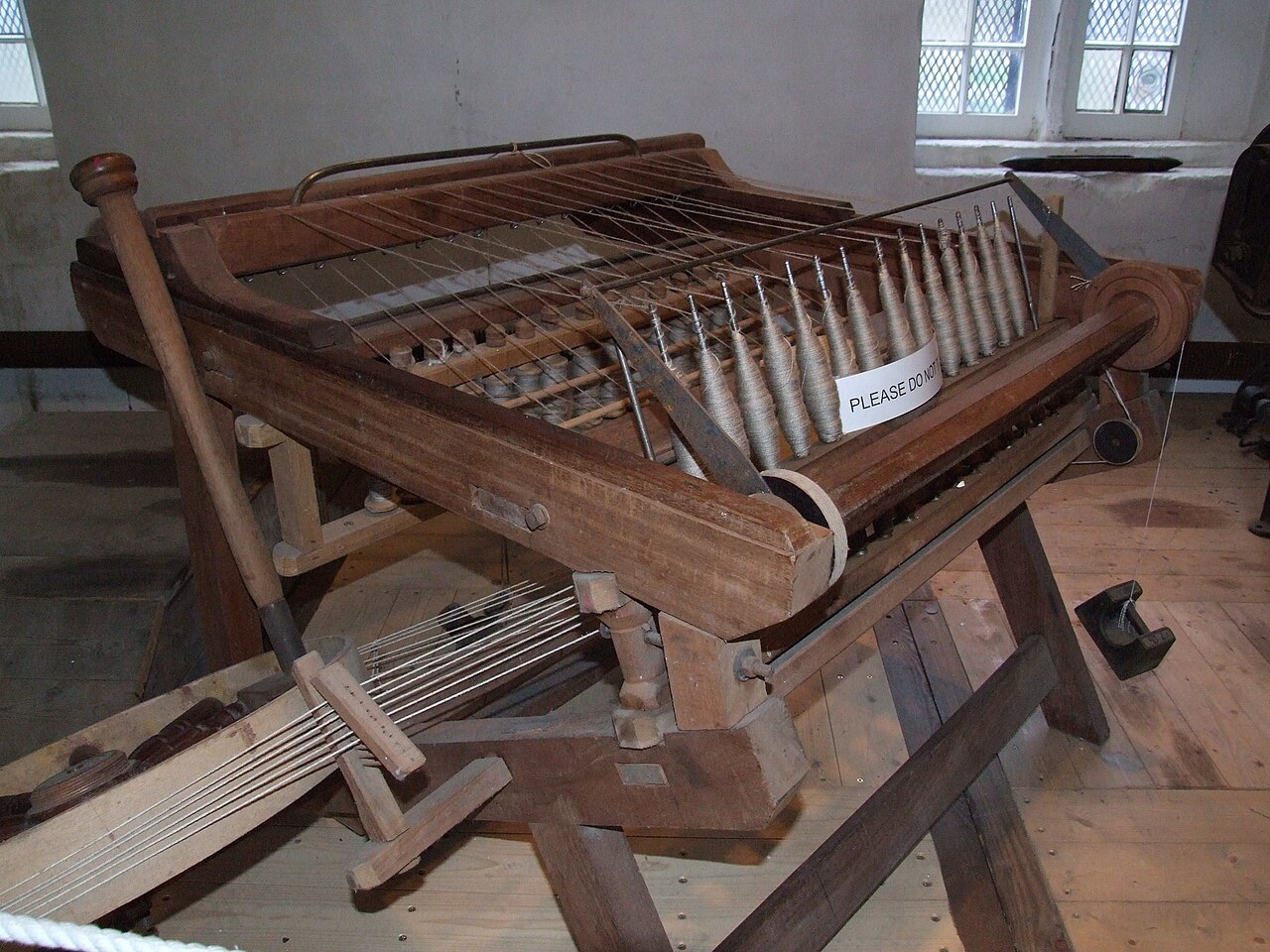
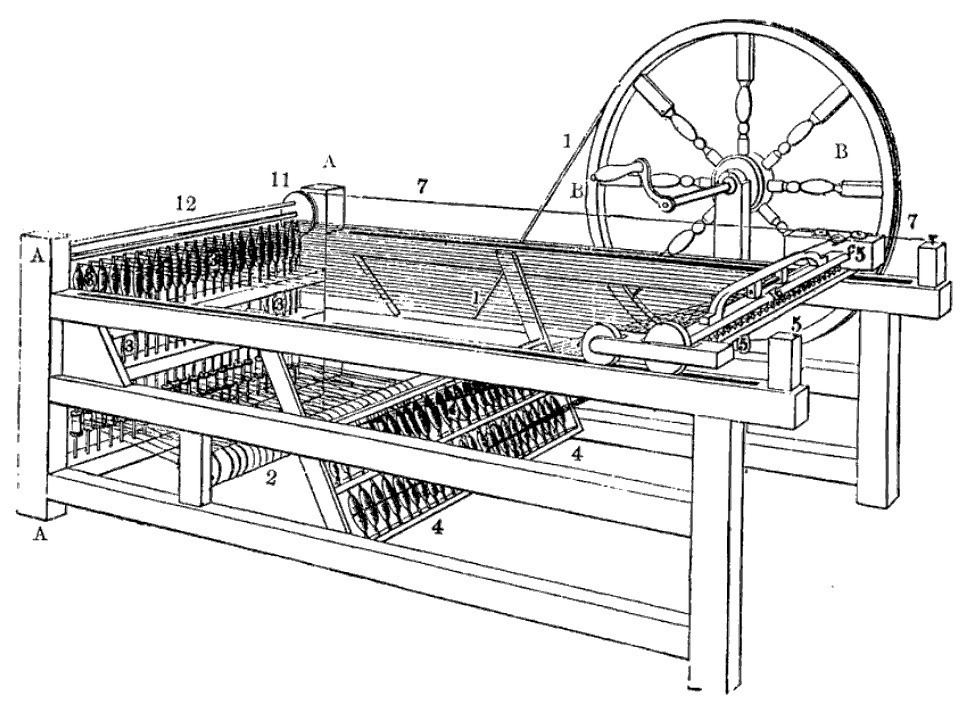
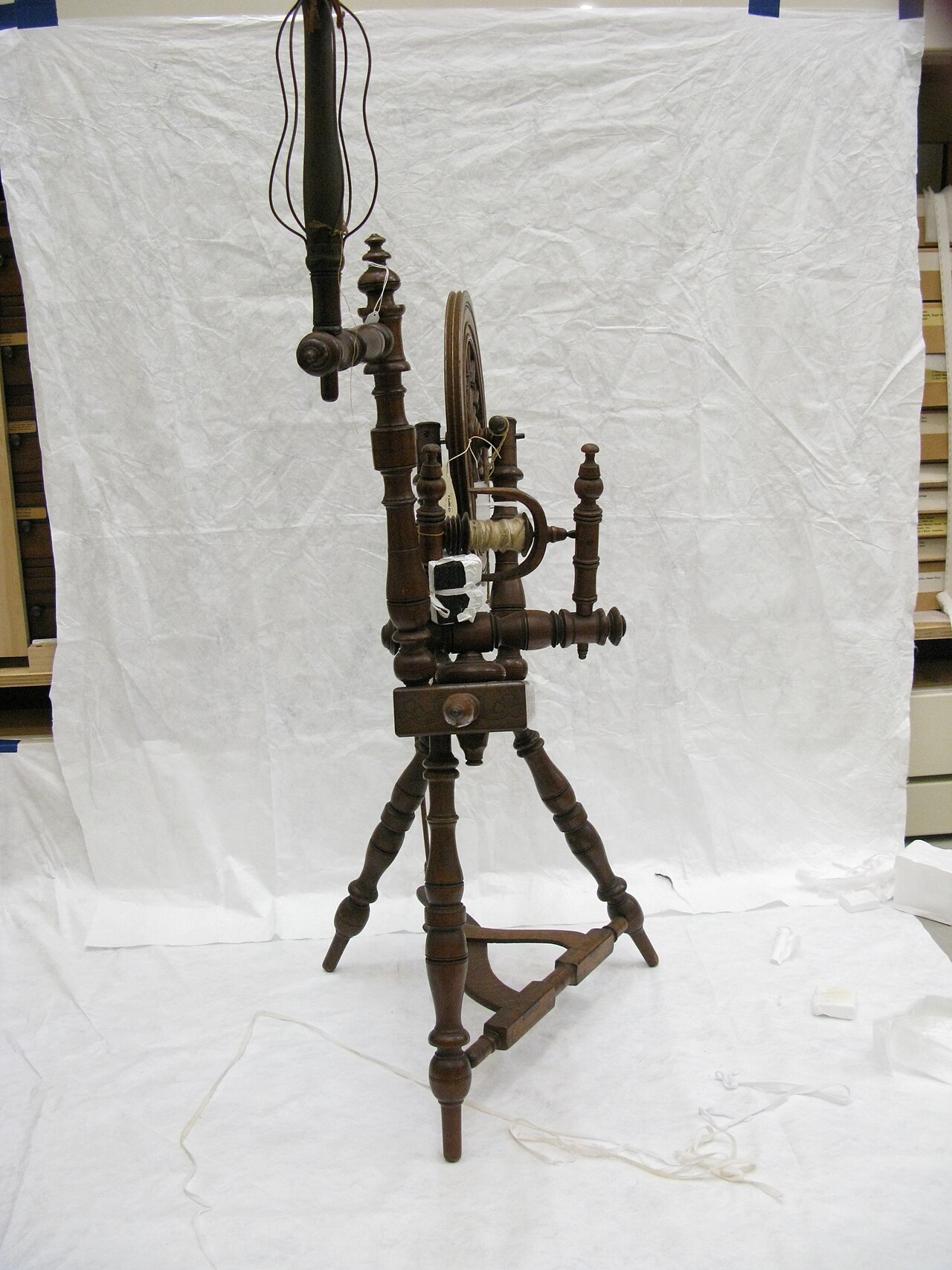
The machine consisted of a wooden frame with eight wooden spindles at one end. Eight rovings were attached to a beam; they passed through two horizontal wooden bars that could be clasped together. The spinner’s left hand drew these bars along the frame, extending the thread, while the right hand turned a wheel that spun all spindles. Returning the bars wound the thread onto the spindle, guided by a pressing wire (faller).
In the 17th century, England’s textile industry centered on wool and worsted cloth, mainly in eastern and southern towns like Norwich. Cotton processing was tiny: only 1,985,868 pounds of cotton-wool were imported in 1701, falling to 1,545,472 pounds by 1730 due to Calico Acts protecting wool. Cheap printed calicoes from India had become popular, so Parliament banned their import in 1700. Grey cloth (unfinished calico) was imported instead and printed in southern England. Lancashire businessmen made grey cloth with linen warp and cotton weft, sending it to London for finishing. By 1720, cotton-wool imports nearly recovered, but another law fined anyone wearing printed calico, exempting muslins, neckcloths, and fustians—a loophole Lancashire exploited. The 1736 Manchester Act allowed colored cotton weft with linen warp, creating artificial demand for woven cloth. In 1764, 3,870,392 pounds of cotton-wool were imported.
Before canals, railways, and turnpikes, goods moved by packhorse along bri
- inventor
- James Hargreaves
- invention_date
- 1764–1765
- place_of_invention
- Stanhill, Oswaldtwistle, Lancashire, England
- field
- Textile manufacturing
- known_for
- Inventing the spinning jenny, a multi-spindle spinning frame
Lore & Background
James Hargreaves was born in Oswaldtwistle, near Blackburn, around 1720. At the time, cotton yarn production could not keep up with demand, and the flying shuttle had increased weavers' productivity. Hargreaves developed the spinning jenny as a wooden frame with eight wooden spindles at one end. A set of eight rovings was attached to a beam; when extended through two horizontal bars clasped together, the spinner drew them along the frame with the left hand while turning a wheel with the right, causing all spindles to revolve. A pressing wire guided the threads onto the spindle.
Hargreaves kept the machine secret for some time, but produced several for his own industry. The price of yarn fell, angering spinners in Blackburn, who broke into his house and smashed his machines, forcing him to flee to Nott
Reader's Guide
The spinning jenny was a pivotal innovation in the early Industrial Revolution, addressing a critical bottleneck in textile production. By allowing a single worker to spin multiple spools simultaneously—initially eight, later up to 120—it dramatically increased yarn output and reduced labour costs. This helped meet the soaring demand created by John Kay's flying shuttle, which had doubled weavers' productivity. The jenny's success spurred the factory system, as cotton manufacturing shifted from dispersed home production to centralized mills.
However, the yarn produced by the jenny was not very strong until Richard Arkwright invented the water-powered water frame. The jenny continued in common use in the cotton and fustian industry until about 1810, when it was superseded by the spinning mule. It was also adapted for slubbing, becoming the basis of the Slubbing Billy. The machine's impact was limited by the need for hand carding, but it nonetheless marked a crucial step toward mechanized textile production and the broader industrial transformation of Britain.
Did You Know?
- The spinning jenny allowed a worker to operate eight or more spools at once, later growing to 120.
- Hargreaves fled to Nottingham in 1768 after spinners smashed his machines in Blackburn.
- The name 'jenny' may be an abbreviation of 'engine', as Hargreaves had no daughter or wife named Jenny.
- The spinning jenny was superseded by the spinning mule around 1810.
Invention and Mechanical Design
James Hargreaves, born around 1720 in Oswaldtwistle near Blackburn, devised the spinning jenny in 1764 or 1765 in the small Lancashire village of Stanhill. The machine's core was a metal frame fitted with eight wooden spindles at one end, with a set of eight rovings fixed to a beam on the frame. Two horizontal wooden bars, capable of being clasped together, sat above the frame. In operation, the spinner's left hand drew these bars along the top of the frame, stretching the thread taut, while the right hand cranked a wheel that set every spindle revolving simultaneously. Returning the bars allowed the newly spun thread to wind neatly onto each spindle, with a pressing wire—called a faller—ensuring the thread landed in the correct position. The jenny produced a coarse thread, and a single operator could manage eight spools at once, a figure that would eventually climb to 120 as the design matured. Hargreaves kept the invention closely guarded for a period, manufacturing several units to supply his own expanding trade before word spread and the wider spinning community took notice.
The Spinning Bottleneck and Domestic Economy
Before the jenny arrived, the English textile trade operated on a painfully slow chain. A handloom weaver might spend part of each day walking to neighbouring households to collect whatever weft they had spun. The division of labour was rigid: three carders were needed to feed one spinner, and as many as three spinners to supply a single weaver. The work was continuous and fell on every member of a household, regardless of age or sex, often alongside a few acres of farming. By 1740 the putting-out system had reorganised this: fustian masters distributed raw cotton and warps to weavers, who then coordinated the carding, spinning, and weaving to specification before the master collected the grey cloth for finishing and sale in Manchester. A twelve-pound piece of eighteenpenny weft required fourteen days of hand-weaving and earned thirty-six shillings, of which nine went to spinning and nine to carding. Transport relied on strings of packhorses along bridle paths, with merchants spending most of the year on the road. When John Kay's flying shuttle of 1733 doubled weaving output, the spinning stage became the critical chokepoint, and the pressure to mechanise that step became irresistible.
Cotton Politics and Legislative Protectionism
England's textile landscape in the late seventeenth century was dominated by woollen and worsted cloth, with centres like Norwich fiercely guarding their trade. Cotton processing was marginal: imports of raw cotton-wool stood at roughly 1.99 million pounds in 1701, then slipped to about 1.55 million by 1730. The Calico Acts, passed to shield the woollen industry, banned the importation of dyed or printed calicoes from India, China, and Persia in 1700. The workaround was to bring in unprinted grey cloth and finish it domestically in southern England. Lancashire merchants exploited a loophole—muslins, neckcloths, and fustians were exempt from a later law fining anyone caught wearing printed calico—and built a trade in grey cloth combining linen warp with cotton weft, sent to London for finishing. By 1720 cotton-wool imports had nearly recovered to their 1701 level. The 1736 Manchester Act then permitted coloured cotton weft on linen warp, creating what amounted to an artificial demand for woven cloth. By 1764, imports had surged to nearly 3.87 million pounds. Blackburn, a town of about five thousand, had become known for its Blackburn greys, a product that would soon demand far more yarn than hand-spinning could supply.
Productivity Gains, Backlash, and the Road to Factories
The spinning jenny's most immediate effect was a dramatic reduction in the labour required to produce cloth. Where a spinner had previously managed a single spindle, the jenny let one worker tend eight or more at once, a capacity that would stretch to 120 as the design evolved. Yet the yarn it produced remained relatively coarse and weak; it was not until Richard Arkwright developed his water-powered water frame that the strength of the thread improved sufficiently for heavier applications. Even so, the jenny's contribution to the factory system of cotton manufacturing was foundational. Hargreaves initially kept the machine under wraps, building a small number of units for his own trade. But as yarn prices fell, the large community of hand-spinners in Blackburn saw their livelihoods threatened. They broke into his home and smashed his machines, compelling him to flee the area. The episode underscored a broader truth: the jenny, born from the simple bottleneck of feeding faster looms with adequate yarn, was one of the pivotal developments that set the early Industrial Revolution in motion.
Gallery

More in Textile Production 1-17
Spotted an error? Know more?
This is a living reference — every entry is fact-audited, and reader corrections feed straight into our audit queue. Suggest an edit · See this site's audit record