Weaving
A method of interlacing threads at right angles to form fabric.
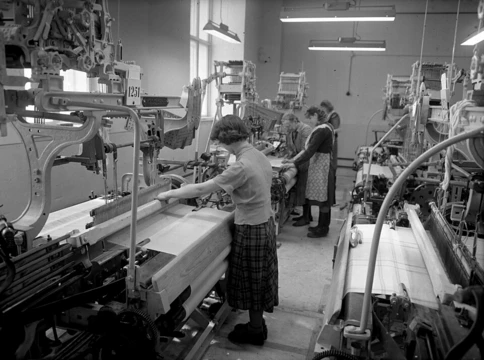
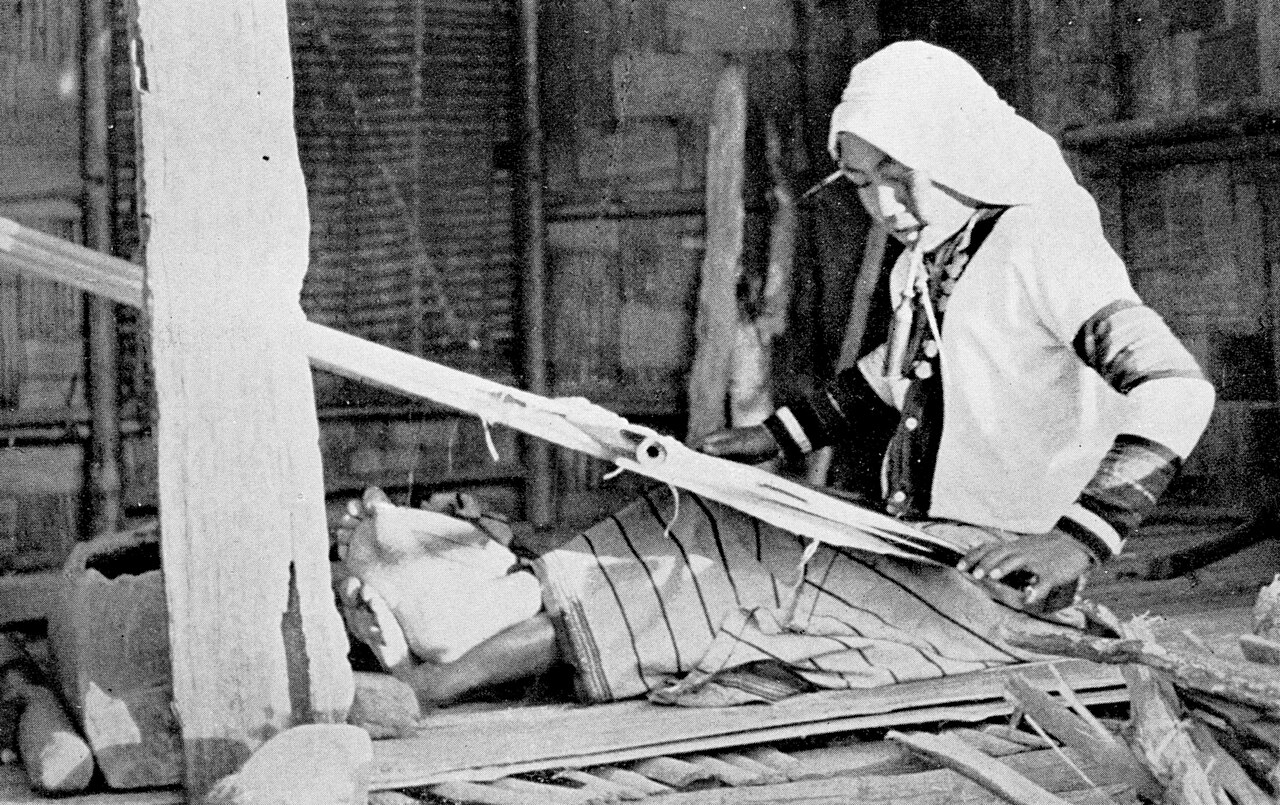
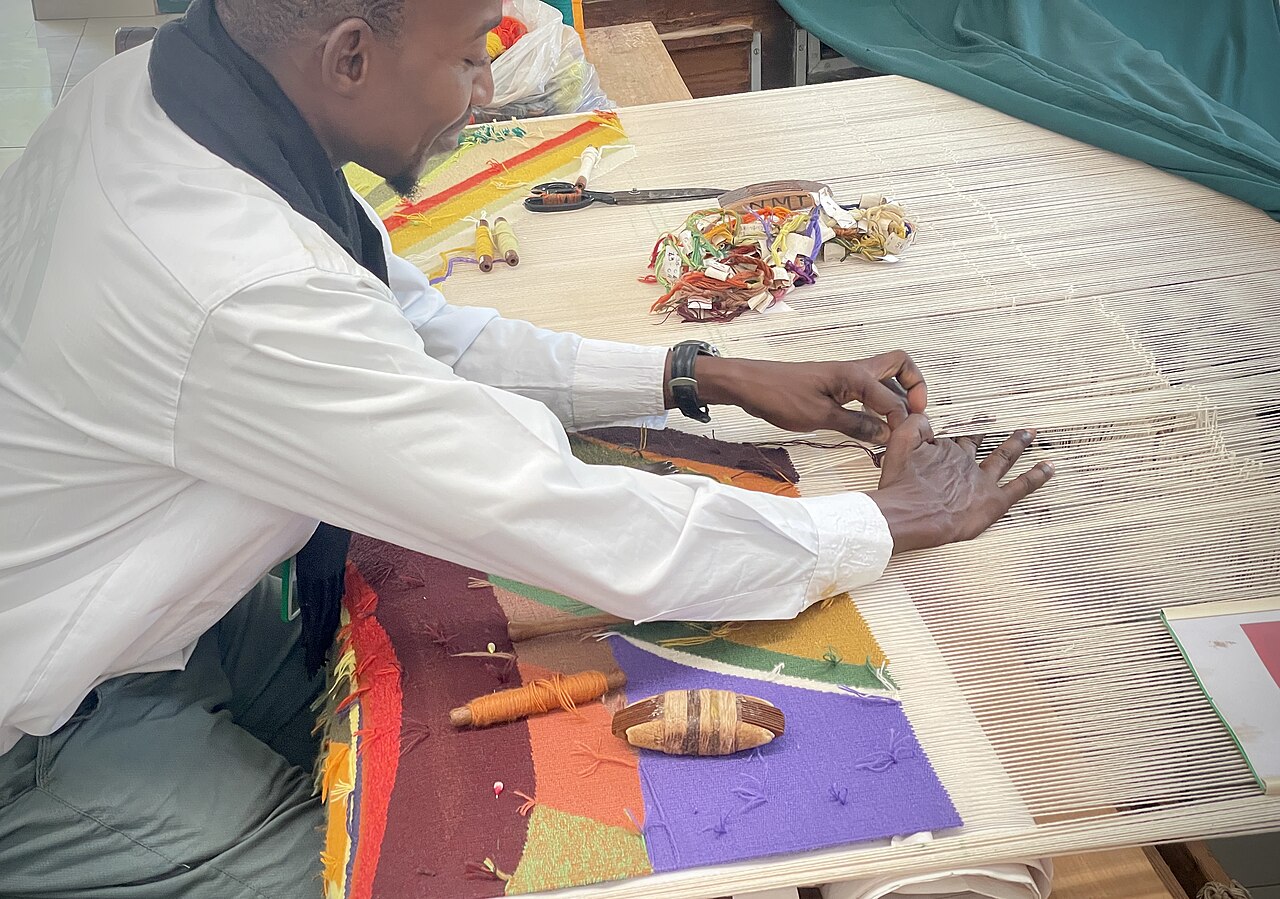
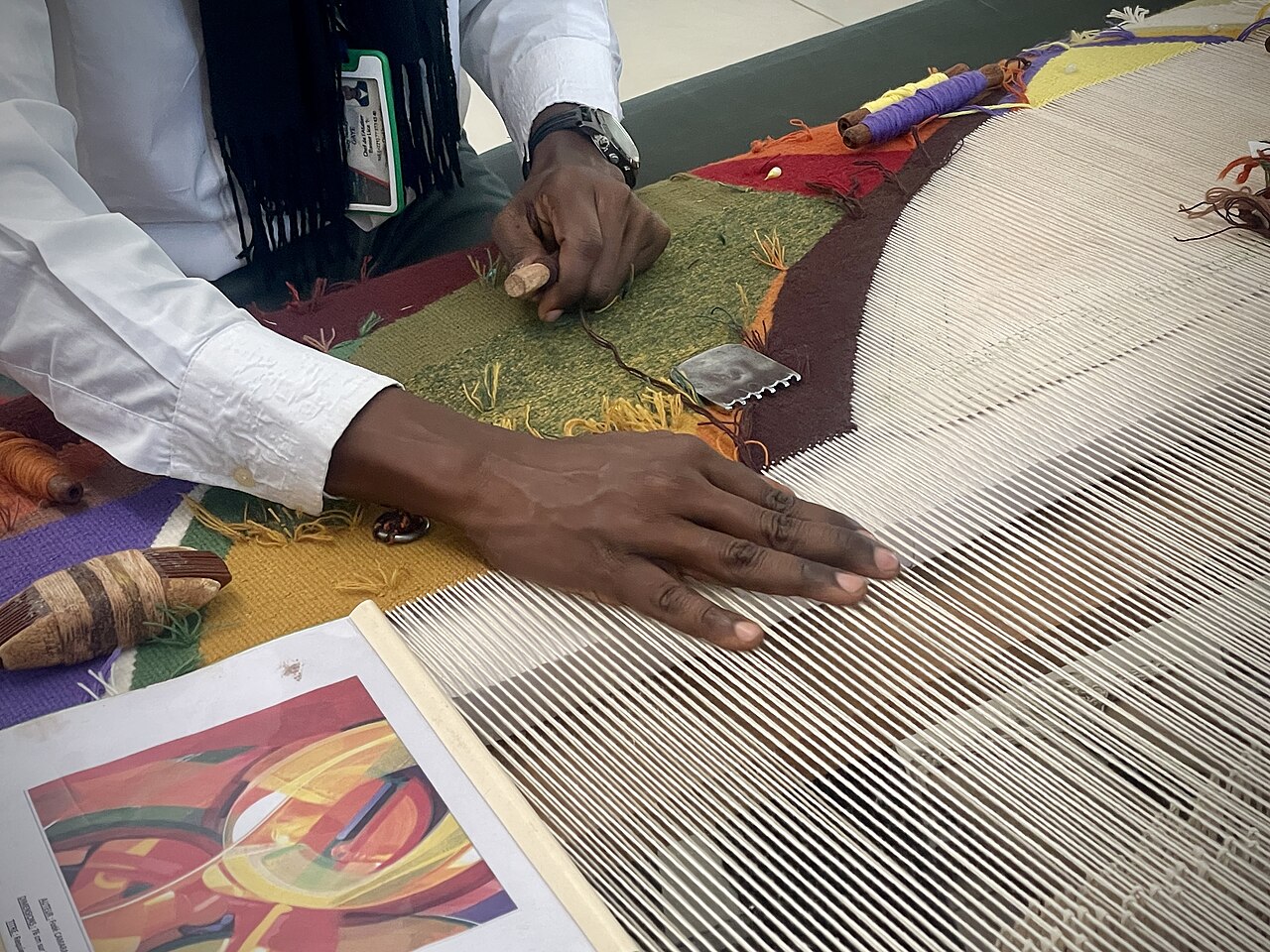
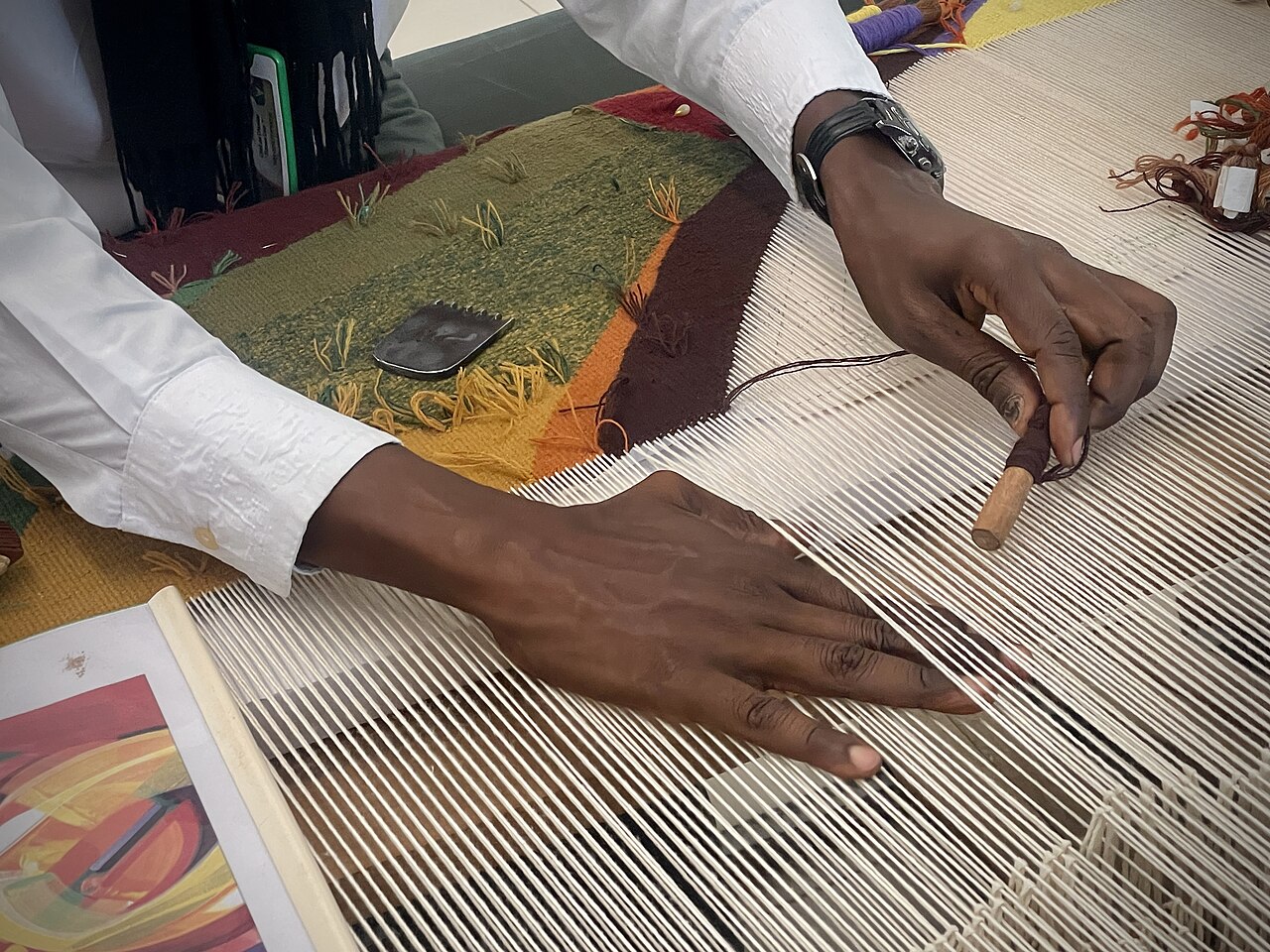
Weaving creates fabric by interlacing two sets of threads at right angles. The lengthwise threads are the warp, and the crosswise threads are the weft (also called woof or filling). How these threads are interwoven determines the cloth's properties. Most cloth is made on a loom, which holds the warp taut while the weft is woven through. However, fabric meeting this definition can also be produced without a loom, using methods like tablet weaving or a backstrap loom.
The interlacement pattern is called the weave. Most woven goods use one of three basic weaves: plain, satin, or twill. Woven cloth can be plain or classic—a single color or simple pattern—or it can feature decorative or artistic designs.
In the weaving process, a loom interlaces two thread sets at right angles. A single warp thread is an "end," and a single weft thread is a "pick." The warp ends are held parallel and taut on the loom, of which many types exist. Weaving repeats three primary motions: shedding (raising or lowering heald frames to separate warp ends, creating a space called the shed for the pick), picking (propelling the weft across the loom by hand, air-jet, rapier, or shuttle), and beating-up (pushing the weft against the cloth's fell with the reed). The warp is divided into two overlapping groups running in two planes, one above the other, so the shuttle passes between them in a straight line. Then the upper group lowers and the lower group raises (shedding), allowing the shuttle to pass back. Without beating-up, the spacing between wefts would be irregular and too large.
Secondary loom motions include let-off (releasing warp from the warp beam at a regulated speed for even filling) and take-up (rolling up the woven fabric to maintain filling density). Tertiary motions are stop motions that halt the loom if a thread breaks—either a warp stop motion or a weft stop motion.
A loom's main parts are the frame, warp beam, cloth-roll (apron bar), heddles with their mounting, and the reed. The warp beam, a wooden or metal cylinder at the back, delivers the warp. Threads run in parallel from the warp beam to the front, where they attach to the cloth-roll. Each warp thread passes through an eye in a heddle. Heddles separate threads into groups, each drawn up and down automatically. For small patterns, cams move the heddles via a harness; for larger patterns, a dobby mechanism uses pegs
- field
- Textile production
- known_for
- Interlacing warp and weft threads to create fabric
- earliest_evidence
- Paleolithic Era, as early as 27,000 years ago
- oldest_known_textiles_in_Americas
- Guitarrero Cave, Peru, dated between 10,100 and 9080 BCE
Lore & Background
Weaving involves using a loom to interlace two sets of threads at right angles: the warp (longitudinal) and the weft (lateral). The primary motions of the loom are shedding (separating warp threads), picking (propelling the weft across), and beating-up (pushing the weft against the cloth). Secondary motions include let off and take up, while tertiary motions are stop motions for thread breaks. The principal parts of a loom are the frame, warp-beam, cloth-roll, heddles, and reed. The warp threads pass through heddles, which are raised and lowered to form a shed for the shuttle to pass through. On power looms, picking is done by hitting the shuttle with overpick or underpick mechanisms. Rapier-type weaving machines use grippers to carry weft across, and some use compressed air. The warp is sized in a starch mixture for smoother running.
Reader's Guide
Weaving has been practiced since the Paleolithic Era, with evidence from 27,000 years ago at the Dolní Věstonice site, where imprints in clay and burned remnants of cloth were found. The oldest known textiles in the Americas, from Guitarrero Cave, Peru, date between 10,100 and 9080 BCE. A hemp cloth fragment from Çatalhöyük dates to around 7000 BCE, and a Neolithic fragment from Fayum, Egypt, from about 5000 BCE, shows plain weave at 12 threads by 9 threads per centimetre. The oldest-known weavings in North America, from the Windover Archaeological Site in Florida, date from 4900 to 6500 BCE and include twined and plain weave textiles with up to 26 strands per inch. These finds demonstrate the long history and global spread of weaving, which remains fundamental to textile production. The three basic weaves—plain, twill, and satin—form the majority of woven products, with complex designs possible through Jacquard mechanisms.
Did You Know?
- Weaving was already known in the Paleolithic Era, as early as 27,000 years ago, based on an indistinct textile impression at the Dolní Věstonice site.
- The oldest known textiles in the Americas, from Guitarrero Cave, Peru, are dated between 10,100 and 9080 BCE.
- A piece of cloth woven from hemp found at Çatalhöyük is suggested to be from around 7000 BCE.
- The oldest-known weavings in North America, from the Windover Archaeological Site in Florida, date from 4900 to 6500 BCE and include fabrics with 26 strands per inch.
The Origins of Human Clothing
The act of covering the body with material is, as far as we know, uniquely human. Anthropologists trace this behavior to practical necessity: as our ancestors spread beyond the warm regions of Africa into colder, wetter, or hotter environments, they needed protection. Animal hides and plant materials were the first available resources, fashioned into rudimentary coverings against wind, rain, and temperature extremes. Because these early garments were made from organic, biodegradable substances, they left virtually no physical trace in the archaeological record. This absence of direct evidence has made it extraordinarily difficult for researchers to pin down when the first humans actually put on a piece of clothing. Estimates from various scholars span an astonishing range, from roughly 40,000 years ago to as far back as three million years, reflecting the deep uncertainty that surrounds this foundational moment in human history. Even the 2021 Moroccan deposits, which offered physical evidence of garments dating between 90,000 and 120,000 years, did not settle the debate. What remains clear is that clothing emerged not as a single invention but as a gradual, climate-driven adaptation that accompanied the northward migration of modern Homo sapiens out of Africa.
Reading the Genetic Clock: Lice as Time Capsules
Because early garments decayed within seasons, scientists turned to an unlikely witness: the body louse. Unlike its head-louse cousin, the body louse cannot survive more than a few hours away from woven or knitted fabric, meaning it could only have evolved once humans began wearing clothing. Researchers Ralf Kittler, Manfred Kayser, and Mark Stoneking at the Max Planck Institute for Evolutionary Anthropology exploited this biological constraint. By measuring the accumulated genetic mutations between the body louse, the head louse, and their shared ancestor, they could estimate when the body louse first speciated—and therefore when clothing first existed. Their 2003 analysis pointed to roughly 107,000 years ago, while a 2011 follow-up pushed the most probable date to around 170,000 years. A separate group using similar genetic-clock methods arrived at a window between 30,000 and 114,000 years. Some of these earlier estimates even predate the first known exodus of Homo sapiens from Africa, raising the tantalizing possibility that extinct hominin relatives may have worn garments first, and that our species acquired the body louse from their discarded clothing in colder regions. No single figure has achieved consensus, yet the lice-based approach remains one of the most inventive tools in the field.
From Hides to Thread: The Material Revolution
The transition from draped animal skins to true woven fabric marks one of humanity's great technological leaps. The earliest concrete evidence of textile production comes from China, where silk weaving has been documented as far back as 8,500 years. In the Indus Valley, mineralized cotton fibers trapped inside copper beads at the Neolithic site of Mehrgarh push the story of cotton use to approximately 6,000 BC, while cotton spinning in India is dated to around 3,000 BC. Even earlier, the oldest known dyed flax fibers were recovered from a prehistoric cave in the Republic of Georgia, carrying a date of 36,000 years. The tools that made all of this possible were equally ancient: a needlepoint fragment from Sibudu Cave in South Africa may be 60,000 years old, and a more complete sewing needle from Denisova Cave in Siberia is at least 50,000 years old, likely crafted by Denisovans before Neanderthals and modern humans ever reached that site. By the late Stone Age, felted and spun fibers were being netted, looped, knitted, or woven into fabrics across the Middle East, and from that point forward the methods of textile production have evolved continuously, shaping how every subsequent civilization dressed, stored, and decorated its world.
Dress as Identity: The Social Life of Early Garments
Long before written records, clothing already carried meaning. Paleolithic cave paintings and figurines from roughly 30,000 years ago show humans draped in skin coverings, while textile clothing appears in the archaeological record around 27,000 years ago, with actual fabric fragments surviving from 7000 BC. The Venus figurine of Lespugue, carved 25,000 years ago in the Pyrenees of southern France, depicts a figure wearing what appears to be a cloth or twisted-fiber skirt. Other figurines from Western Europe show basket hats, waist belts, and cloth straps wrapped above the breast; Eastern European examples feature low-hanging belts and string skirts. Archaeologists James M. Adovasio, Soffer, and Hyland argue that many of these depicted garments were more likely ritual wear—real or imagined—serving as markers of distinct social categories rather than everyday practical dress. This interpretation aligns with a broader principle in material culture studies: the variety, distribution, and decoration of textiles within any society reveal its customs, hierarchies, and values. Sources for reconstructing this social history include excavated material remains, artistic representations of weaving and garment-making, and documentary records of fabric trade and use, all of which together paint a picture of clothing as a social, not merely functional, human invention.
Gallery
More in Textile Production 1-17
Spotted an error? Know more?
This is a living reference — every entry is fact-audited, and reader corrections feed straight into our audit queue. Suggest an edit · See this site's audit record