Spindle (textiles)
A hand tool for twisting fibers into yarn.

Wikipedia / Wikimedia Commons
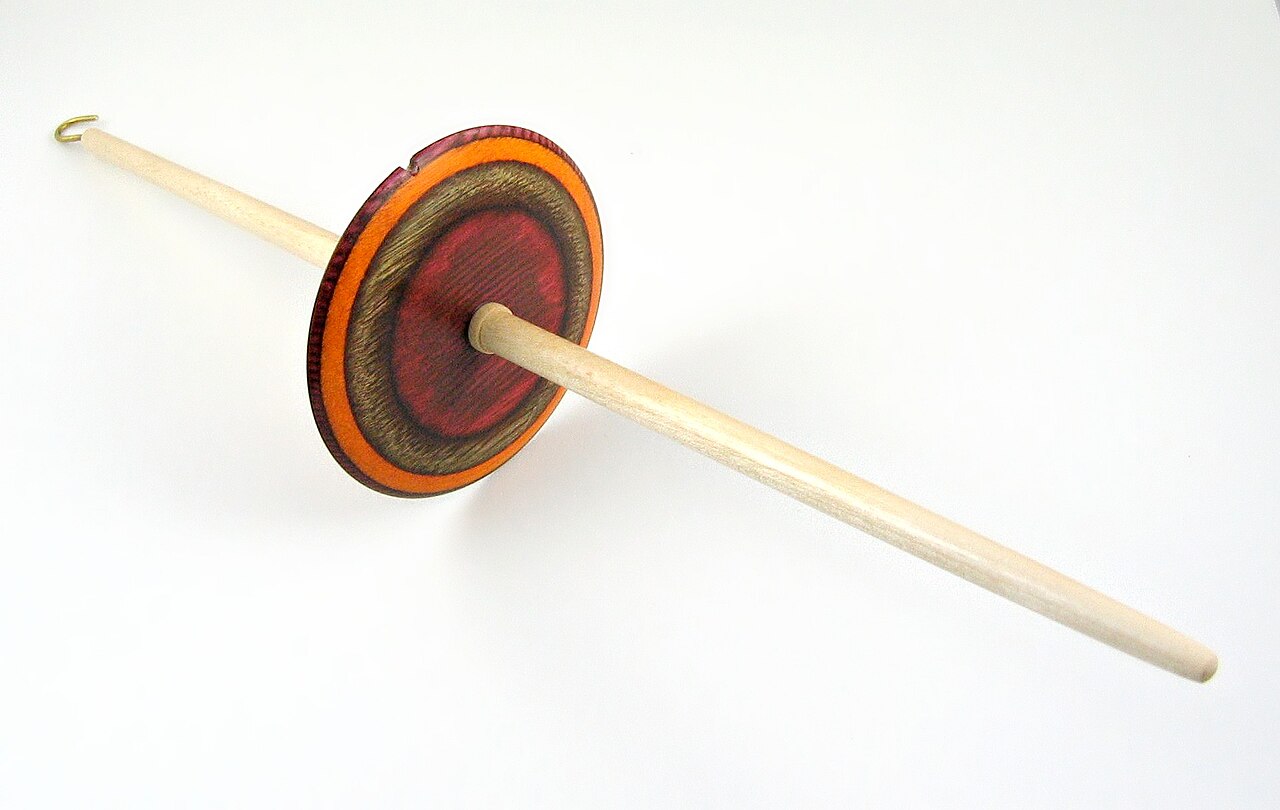
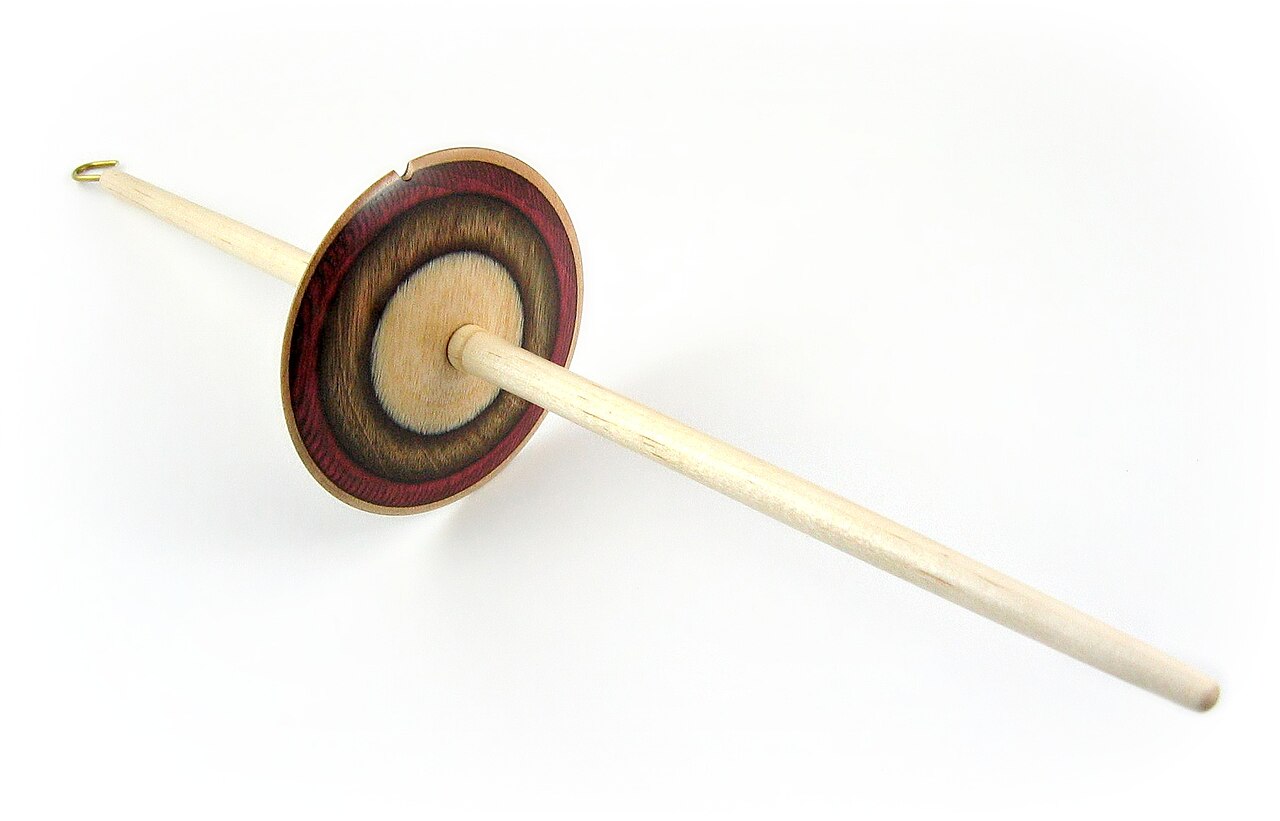
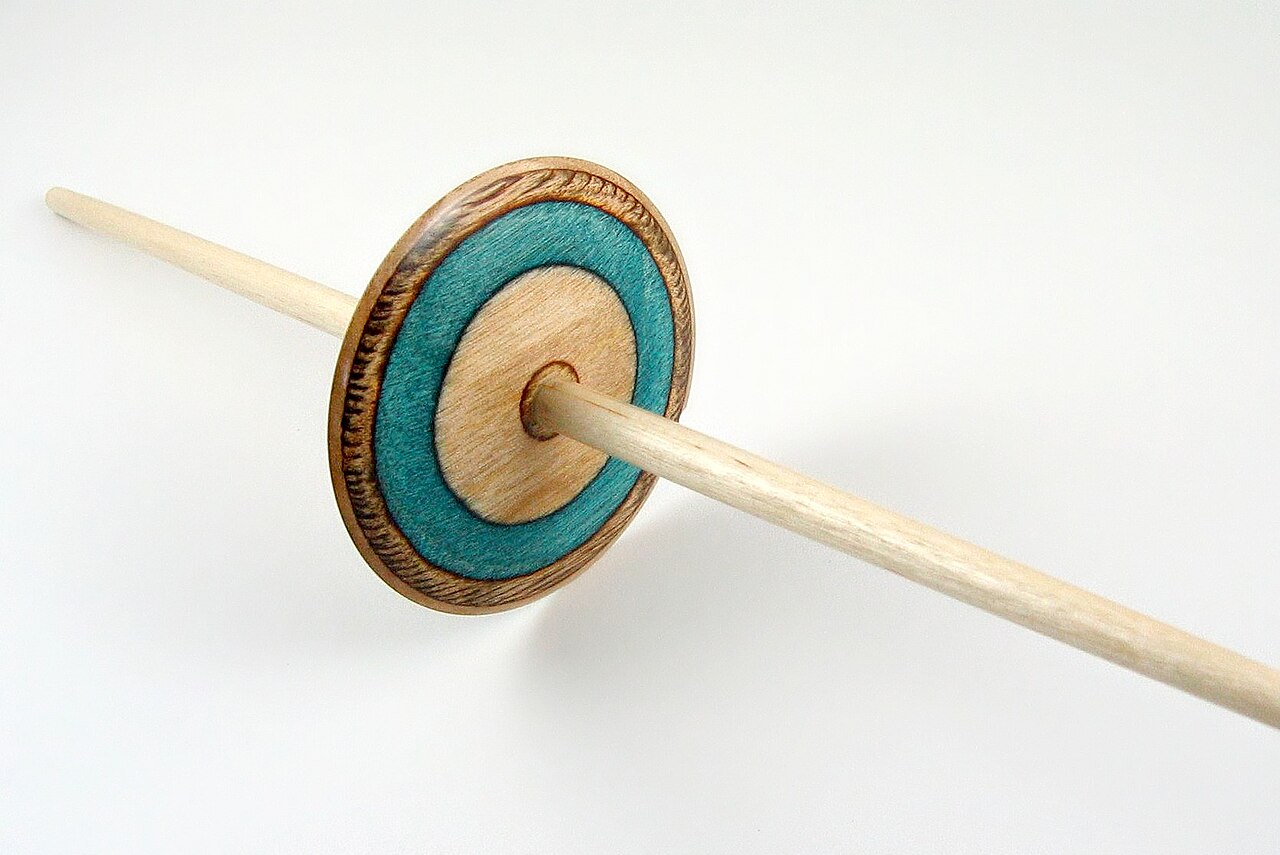
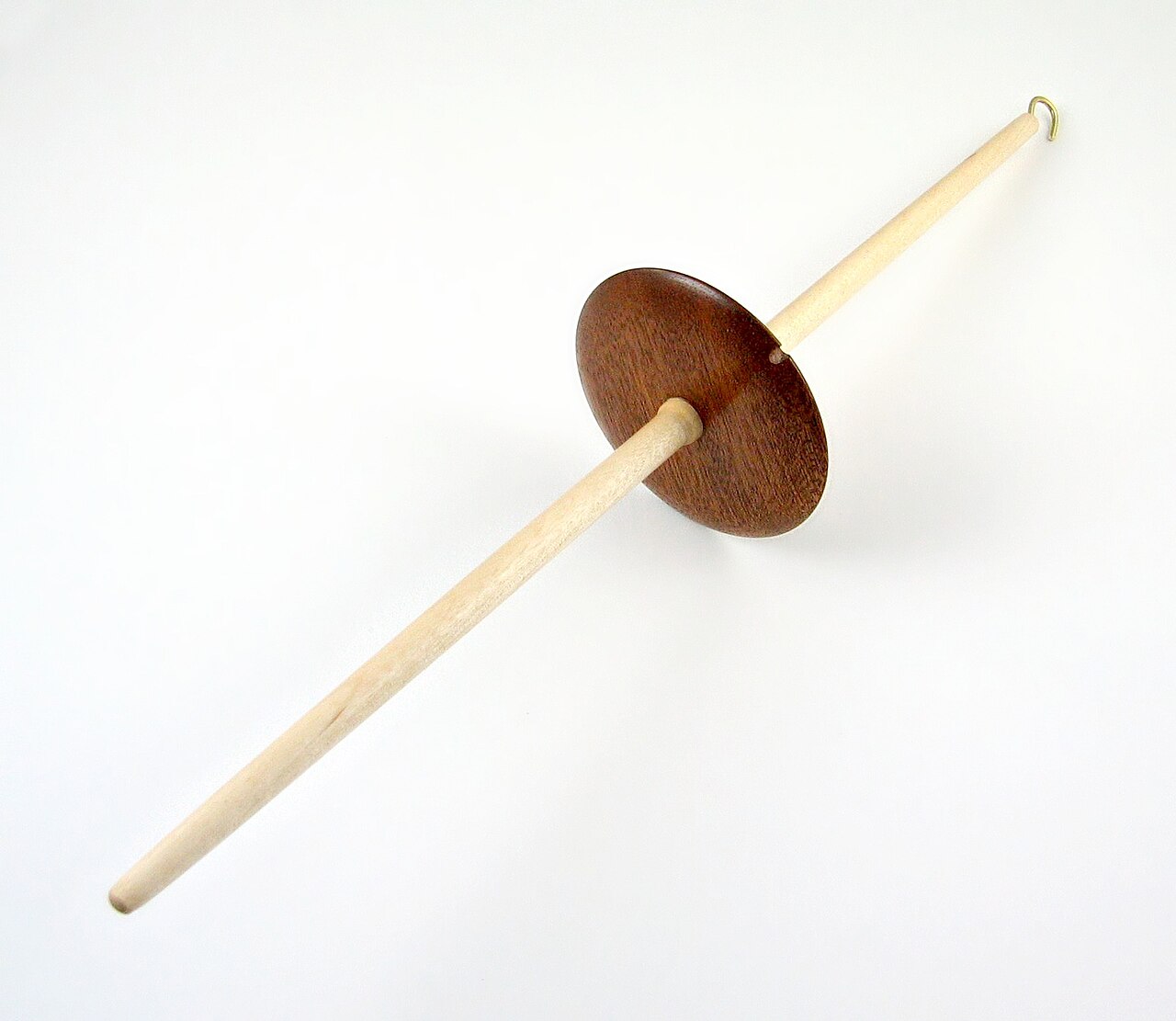
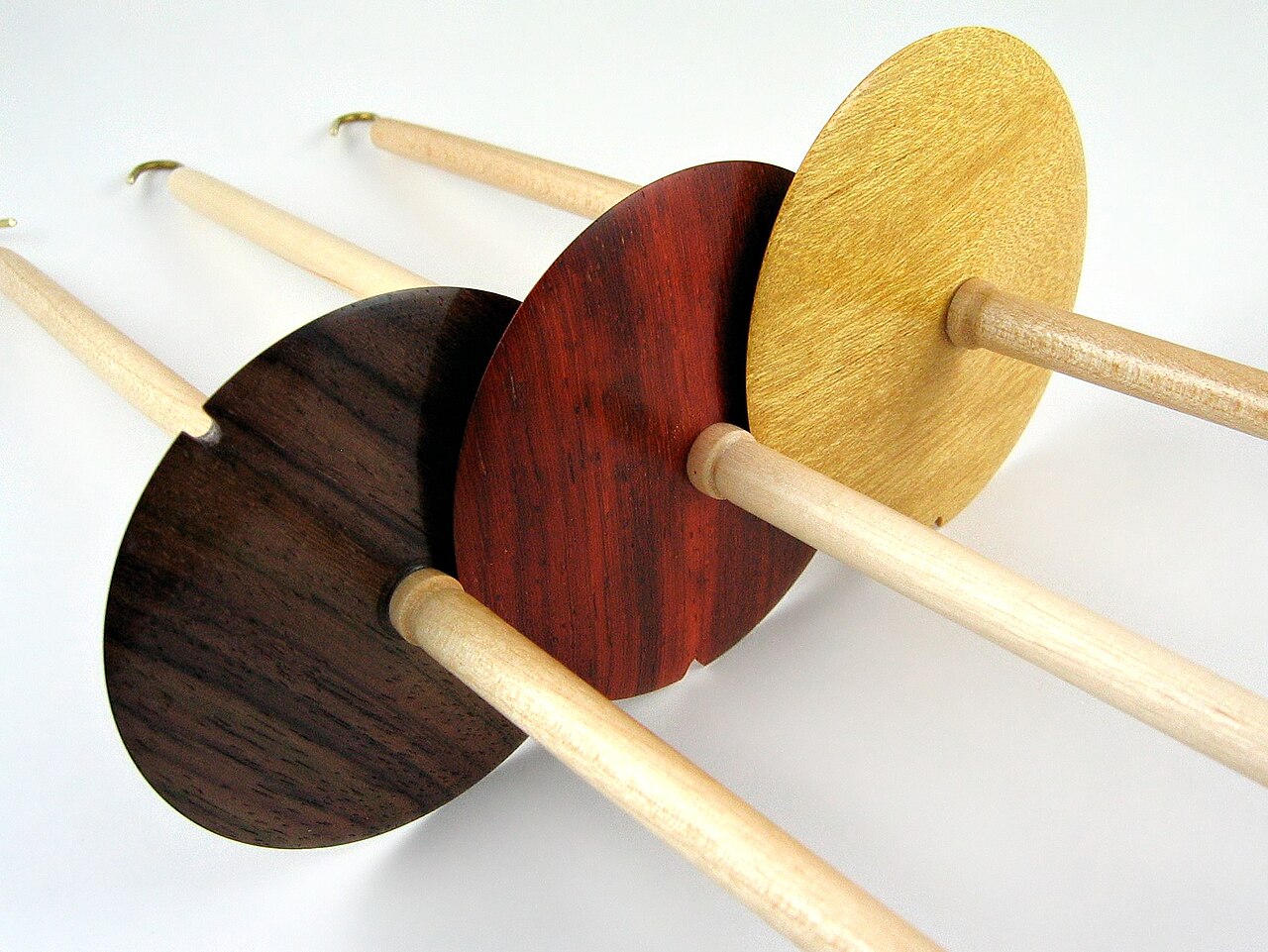
A spindle is a straight, pointed tool, typically carved from wood, that twists fibers like wool, flax, hemp, or cotton into yarn. Many spindles have a weight—called a whorl—attached at the top, middle, or bottom, often a disc or sphere, though some spindles (like Orenburg and French styles) are weighted simply by making the shaft thicker toward the base. The top may include a hook, groove, or notch to guide the yarn. Spindles come in various sizes and weights, chosen according to the thickness of the yarn being spun.
The earliest wooden spindles are unknown because the materials decayed. Whorl-weighted spindles have been used since at least the Neolithic period, with whorls found in archaeological sites worldwide. The earliest widely accepted evidence of spindle whorls comes from Neolithic sites around 8,000–9,000 years ago. While some possible whorl remains were discovered at the Natufian village of Nahal Ein Gev II in Israel, dating back 12,000 years, this identification is disputed and not widely accepted by mainstream archaeology. Spindles also appear in traditional spinning wheels, where they lie horizontally—for example, in the Indian charkha and the great or walking wheel. In industrial yarn production, the term 'spindle' refers to a rotating shaft, not the hand tool, and machines like the spinning jenny, spinning mule, and ring spinning use bobbins, flyers, and rings instead. Traditionally, spindles were often made from the wood of *Euonymus europaeus*, which gave the spindle bush its English name.
Modern hand spindles fall into three main types: suspended, supported, and grasped. Suspended and supported spindles are usually held vertically; grasped spindles can be held vertically, horizontally, or at an angle, depending on tradition.
Suspended spindles hang from the yarn after spinning begins. Drop spindles, a common suspended type, are allowed to drop as the thread forms, allowing longer yarn before winding on. They also let the spinner move around while working. However, their size and weight have practical limits.
Supported spindles rest their tip on the spinner’s thigh, the ground, a table, or a small bowl while rotating. They vary greatly in size—from the large Navajo spindle (about 30 inches) to the small, fast metal takli for cotton, and the tiny Orenburg spindles (roughly 20 cm, 15 grams) for gossamer lace yarns.
Grasped spindles are al
- field
- Textile production
- known_for
- Hand spinning of yarn
- materials
- Wood, metal, bone, plastic, glass, stone, clay
- earliest_evidence
- Neolithic sites, around 8,000–9,000 years ago (disputed earlier evidence from Nahal Ein Gev II, Israel, 12,000 years ago)
- traditional_wood
- Euonymus europaeus (spindle bush)
Lore & Background
The origin of the first wooden spindle is lost to history because the materials did not survive. Whorl-weighted spindles date back at least to Neolithic times, with the earliest widely accepted evidence from sites around 8,000–9,000 years ago. Possible remains from the Natufian village at Nahal Ein Gev II, Israel, dating 12,000 years ago, are disputed and not broadly accepted by mainstream archaeology. Spindles are also part of traditional spinning wheels, such as the Indian charkha and the great or walking wheel. In industrial yarn production, the term 'spindle' refers to a rotating shaft, not the hand tool, and machines like the spinning jenny, spinning mule, and ring spinning use bobbins, flyers, and rings instead.
Modern hand spindles fall into three basic categories: suspended spindles, supported
Reader's Guide
The spindle is a foundational tool in the history of textile production, enabling the conversion of raw fibers into yarn for thousands of years. Its design has varied widely across cultures, with spindles made from wood, metal, bone, or plastic, and weighted by whorls of stone, clay, glass, or other materials. The location of the whorl—top, bottom, or center—affects the spindle's stability and spin characteristics, while the shaft thickness influences spin speed. Spindles are categorized into suspended, supported, and grasped types, each suited to different spinning traditions and yarn thicknesses. The spindle's legacy extends beyond handcraft into industrial machinery like the spinning jenny and ring spinning, and it appears in cultural references such as the fairy tales Sleeping Beauty and Rumpelstiltskin. The spindle also has religious significance, linked to goddesses of fate and the Virgin Mary. In biology, the term 'spindle apparatus' describes a structure in cell division, derived from the Greek word for warp thread. The spindle remains a symbol of craftsmanship and continuity in textile arts.
Did You Know?
- Whorl-weighted spindles date back at least to Neolithic times, with possible remains found in a Natufian village from 12000 years ago.
- The wood traditionally favored for making spindles was Euonymus europaeus, from which derives the name spindle bush.
- Suspended spindles allow the spinner to move around while spinning, going about their day.
- The spindle is closely associated with goddesses such as the Germanic Holda and Greek Artemis and Athena.
Ancient Origins and the Whorl Spindle
The earliest evidence of twisted fiber was uncovered in southern France, and archaeologists date it to roughly 50,000–40,000 BC. The precise origins of hand spinning remain unknown, though scholars believe the practice arose independently in multiple cultures well before the common era. In the very beginning, people likely twisted fibers by rolling them along the thigh or pinching them between the fingers. A simple stick soon entered the process, serving to hold tension and maintain the twist. The next major advance came when a weight—carved from stone, wood, or clay and called a whorl—was attached to the stick. This addition preserved rotational momentum and, crucially, freed the spinner's hands to draft the fiber. Whorl spindles remain the primary spinning tool in certain regions to this day. In the ancient kingdom of Meroë, cotton cultivation and the associated spinning and weaving arts reached a remarkable level of sophistication by the fourth century BC, and textile exports became a principal source of the kingdom's wealth. In medieval Europe, hand spinning functioned as a vital cottage industry, with women and children producing wool yarn to feed looms operated by men or to sell through the putting-out system.
The Mechanics of Ring Spinning
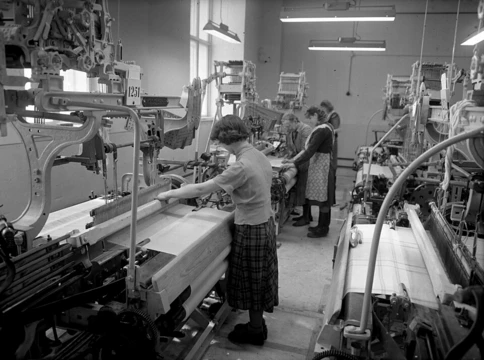
Ring spinning is among the most widely used spinning methods worldwide, and its operation hinges on a delicate interplay between several moving parts. Yarn emerging from the drafting rollers travels through a thread-guide, loops around a small device called a traveller that is free to rotate around a ring, and then winds onto a tube or bobbin mounted on a spindle whose axis passes through the ring's center. The spindle is driven at a constant or slowly varying angular velocity, and the traveller is dragged around the ring by the loop of yarn passing through it. If the drafting rollers were held still, the traveller would rotate at the same rate as the spindle, and each spindle revolution would insert exactly one twist into the yarn between the roller nip and the traveller. In actual spinning, however, yarn is continuously fed from the rollers, so the traveller's angular velocity falls slightly below that of the spindle. That small difference is precisely what allows the yarn to wind onto the bobbin at the same rate it leaves the drafting system. Each revolution of the traveller still deposits one twist, yet in steady-state equilibrium the total number of twists in the working loop stays constant because twisted yarn passes through the traveller at a matching rate.
Fiber Sources and Processing
The raw material for yarn can be either natural or artificial, and the two categories differ substantially in structure and preparation. Artificial fibers are produced by extruding a polymer through a spinneret into a medium where it hardens. Wet spinning, used for rayon, relies on a coagulating bath; dry spinning, used for acetate and triacetate, depends on a solvent that evaporates in a heated exit chamber; and melt spinning, used for nylons and polyesters, cools the extruded polymer in gas or air. All three yield continuous filaments that can stretch for kilometers. Natural fibers fall into three groups: animal (sheep, goat, rabbit, silkworm), mineral (asbestos, gold, silver), and plant (cotton, flax, sisal). Vegetable fibers may come from the seed, the stem—known as bast fibers including flax, hemp, and jute—or the leaf. With the exception of silk, natural fibers are short, measuring only centimeters, and their rough surfaces help them bond with neighboring staples. Before a clean, even staple is obtained, many preparatory processes are required. Artificial fibers, meanwhile, can be processed as long filaments or batched and cut to mimic natural short fibers. Cotton remains the most popular fiber spun into yarn, followed by viscose, wool, and polyester.
From Hand to Machine: The Industrial Transformation
For centuries, the spinning wheel—predominant across Asia and Europe from the sixth century AD—was the principal tool for converting fiber into yarn. The late eighteenth century shattered that rhythm. The spinning jenny and the spinning mule, both invented in the 1770s and 1780s, made mechanical spinning dramatically more efficient than hand work and propelled cotton manufacturing into one of the defining industries of the Industrial Revolution. The spinning mule, descended from Samuel Crompton's 1779 device, operates as an intermittent process: the carriage advances and returns, pulling roving off bobbins through rollers at several different speeds to thin it at a consistent rate. The yarn is twisted as the bobbin spins during the outward stroke and rolled onto a cop on the return. Mule spinning yields a finer, softer, less-twisted thread especially favored for fines and weft. The ring, a descendant of Arkwright's 1769 water frame, works continuously and produces a coarser, stronger, more heavily twisted yarn better suited to warp, though it is slower because the thread must travel the full distance around the ring. Today, pre-industrial hand spinning with a spindle or wheel persists as a handicraft and hobby, allowing wool and unusual vegetable or animal staples to be worked by individuals.
Gallery

More in Textile Production 1-17
Spotted an error? Know more?
This is a living reference — every entry is fact-audited, and reader corrections feed straight into our audit queue. Suggest an edit · See this site's audit record