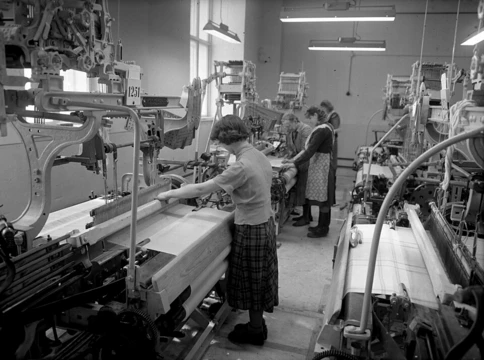
Spinning mule
Machine that spun cotton and wool into yarn.

Wikipedia / Wikimedia Commons
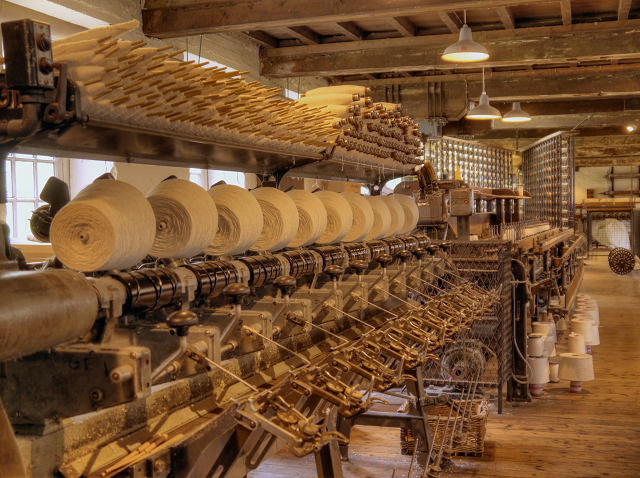
The spinning mule is a machine used to spin cotton and other fibres like wool. It was invented in 1779 by Samuel Crompton and became a dominant spinning machine in the 19th century, though the water frame and spinning jenny remained significant in the early period. The mule was a hybrid of Arkwright's water frame and Hargreaves's spinning jenny, combining their principles to produce strong, thin yarn suitable for any textile.
- peak_spindles_in_Lancashire
- over 40,000,000
Lore & Background
Samuel Crompton invented the spinning mule in 1779, so called because it is a hybrid of Arkwright's water frame and James Hargreaves's spinning jenny, similar to how a mule is a crossbreed. Crompton built his mule from wood, with 48 spindles, and could produce 1 pound of 60s thread a day. He could not afford to patent his invention and sold the rights to a group of manufacturers, who profited from it; no patent was ever granted for the spinning mule. The mule produced strong, thin yarn suitable for warp or weft, first used for cotton then other fibres.
Reader's Guide
The spinning mule was the dominant spinning machine from 1790 to about 1900, extensively used in Lancashire mills. It operated by an intermittent process: on the draw stroke, roving was pulled through rollers and twisted; on the return, it was wrapped onto the spindle. The self-acting mule, patented by Richard Roberts in 1825, automated the process and allowed finer, stronger yarn. At its peak, there were 5,000,000 mule spindles in Lancashire alone. Modern versions still produce woollen yarns from noble fibres like cashmere and alpaca. The mule's rival, the ring frame, used a continuous process but could not produce the finest counts. The mule's legacy includes enabling the mass production of fine cotton and woollen textiles, shaping the Industrial Revolution in textile manufacturing.
Did You Know?
- The spinning mule was named because it is a hybrid of Arkwright's water frame and Hargreaves's spinning jenny, like a mule is a crossbreed.
- Samuel Crompton could not afford to patent his invention and sold the rights to a group of manufacturers; no patent was ever granted.
- At its peak, there were over 40,000,000 mule spindles in Lancashire alone.
- Modern versions of the spinning mule are rarely used for cashmere, ultra-fine merino, and alpaca; such fibres are typically spun on ring or open-end spinning.
The Birth of a Hybrid Machine
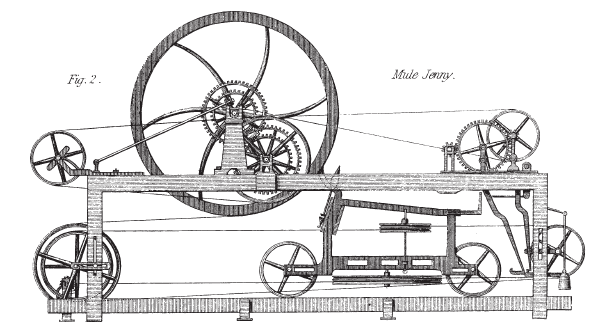
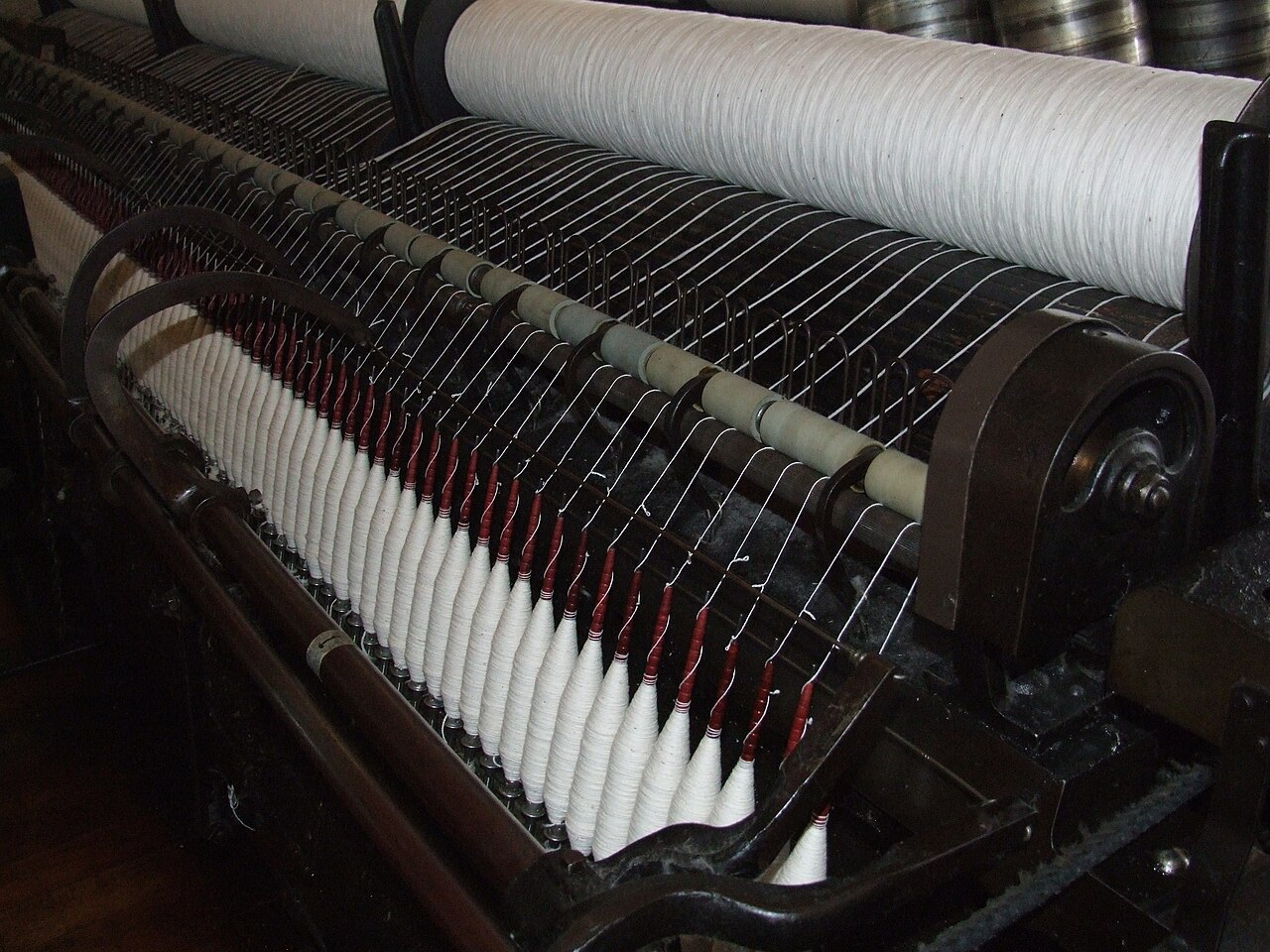
Samuel Crompton conceived the spinning mule between 1775 and 1779, creating what was essentially a mechanical crossbreed. Just as a mule inherits traits from both horse and donkey, Crompton's device married the multi-spindle concept of Hargreaves's spinning jenny with the attenuating-roller system of Arkwright's water frame. The resulting machine featured a stationary frame holding a creel of cylindrical roving bobbins, linked through a headstock to a sliding carriage that carried the spindles. During the outward draw stroke, the roving was pulled through the rollers and twisted; on the return, the thread was clamped and wound onto the spindles as they reversed direction. Crompton's original wooden prototype held just 48 spindles yet could spin a pound of 60s thread daily, demanding a spindle speed of 1,700 revolutions per minute and a mere sixteenth of a horsepower. The yarn it produced was strong enough for both warp and weft applications. Crompton himself could not afford to secure a patent, so he sold the rights to David Dale, who then profited commercially from the invention while Crompton returned to his loom.
The Engine of Lancashire's Mills
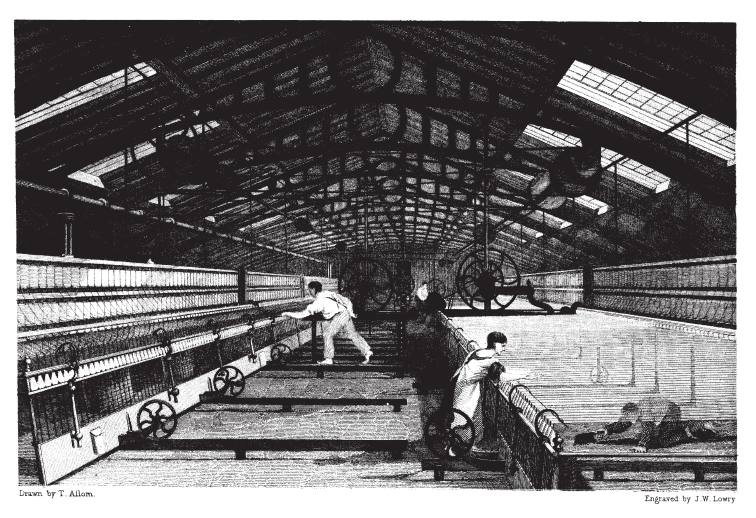
By the 1890s, a single cotton mill in Lancashire might house more than sixty mules, each carriage stretching up to 150 feet and carrying as many as 1,320 spindles. These enormous machines oscillated forward and back over a five-foot travel four times every minute, running for 56 hours a week. At the height of the industry, an estimated five million mule spindles turned in Lancashire alone, making the region the beating heart of global cotton production. Operating a mule was a team effort: a minder supervised a pair of machines while two young boys, the little piecer and the big or side piecer, kept the spindles fed and cleared. The preparatory work of carding, cleaning, and preparing roving created a demand for child labour that persisted until legislation intervened. The sheer volume of yarn produced also provoked violent backlash; frame-breaking riots erupted, culminating in the Luddite uprisings of 1811 to 1813, as handloom weavers and spinners feared their livelihoods were being obliterated by machines that could outproduce them by orders of magnitude.
From Wood to Automation
Crompton's original mule was a wooden contraption driven by bands and pulleys, and after its public release he had little further involvement in its refinement. A succession of mechanics and engineers transformed it over the following decades. Henry Stones of Horwich introduced toothed gearing and, crucially, metal rollers in place of the original wooden ones. Baker of Bury experimented with drum mechanisms, while Hargreaves applied parallel scrolling to smooth out the acceleration and deceleration of the carriage. In 1790, William Kelly of Glasgow devised a new method to assist the draw stroke, initially harnessing animal power and later water as the prime mover, while Wright of Manchester repositioned the headstock to the centre of the machine for improved balance. The most consequential leap came in 1825, when Richard Roberts patented the self-acting mule, automating the return stroke and eliminating the need for a minder to manually reverse the carriage. Over the next century and a half, these incremental advances yielded finer and stronger yarn, keeping the mule competitive against the ring frame—a New England invention from the 1820s that, despite requiring more energy and struggling with the finest counts, was not widely adopted in Lancashire until the 1890s.
A Machine That Refused to Die
The spinning mule dominated textile production from roughly 1790 until the turn of the twentieth century, yet its story did not end with the rise of the ring frame. Because the mule's intermittent process—drawing and twisting in one stroke, wrapping in the next—allowed it to produce the very finest yarn counts that the continuous ring frame could not match, it remained the machine of choice for premium fibres well into the modern era. Mills continued to rely on mules for fine yarns until the early 1980s. Today, modern versions of the spinning mule are still manufactured and put into production, specifically to spin woollen yarns from noble fibres such as cashmere, ultra-fine merino, and alpaca for the high-end knitted textile market. In this way, a machine born in a Lancashire workshop in the late 1770s, originally built from wood and driven by a fraction of a horsepower, has survived more than two centuries of industrial revolution. Its legacy is woven literally into the fabric of the global textile trade, from the cotton mills of the nineteenth century to the luxury knitwear looms of the twenty-first.
Gallery
More in Textile Production 1-17
Spotted an error? Know more?
This is a living reference — every entry is fact-audited, and reader corrections feed straight into our audit queue. Suggest an edit · See this site's audit record